
REVIEW · TUK-TUKS
Tuk Tuk Lisbon: Exploring Urban Art
Lisbon street art looks different at street level. This tuk-tuk route strings together sculpture murals, carved faces, and massive tile work so you actually see how the city talks back. I love the private guide angle, with smart context on artists and neighborhoods, and you get a photo-friendly ride that makes it easier to spot details.
One possible drawback: it is not recommended for pregnant women or people with reduced mobility, and children under 7 are not allowed. If that’s you, it’s worth choosing a different format that fits your pace.
In This Review
- Key things to know before you go
- Why Lisbon street art loves a tuk-tuk ride
- Price and timing for the $93.73 mural tour
- Pickup, meeting points, and what the private setup means
- Santa Apolónia and Pichi&Avo’s graffiti-meets-sculpture wall
- Santa Clara Field: André Saraiva’s 53,000 tiles
- Vhils in Travessa das Merceeiras, face carved from the street
- Graça literary portraits and two viewpoint stops
- Avenida Fontes Pereira de Melo: Os Gémeos, Blu, and other heavy hitters
- Lx Factory and Bordalo II’s garbage bee
- The guides: what makes the storytelling land
- Should you book this Tuk Tuk Lisbon urban-art tour
- FAQ
- How long is the Tuk Tuk Lisbon urban art tour?
- What does the tour cost?
- Is pickup included?
- Is this tour private?
- Are there age or mobility restrictions?
- What is included in the price, and what is not?
Key things to know before you go
- Small private setup (up to 6 seats) keeps the stops flexible for your group
- Pickup around Lisbon’s historic center plus cruise terminals, with helpful meeting point options
- English-speaking private guide who explains street art and the streets it lives on
- Big-name urban art, close up from Pichi&Avo to Bordalo II
- Photo time can be built into the drive when traffic allows, so you are not rushing the camera
Other tuk tuk runs around Lisbon we have squeezed into
- True 4Hour Private Tuk Tuk Tour: Discover Lisbon with a Local!★ 5.0 · 8,008 reviews
- Lisbon: Private Guided Tuk-Tuk Tour with Hotel Pickup★ 4.9 · 4,552 reviews
- Private Lisbon Sightseeing Tuk-Tuk Tour: Alfama, Belém & More★ 5.0 · 4,277 reviews
- Lisbon Highlights: Private Tuk Tuk Tour Adventure Sightseeing★ 5.0 · 3,284 reviews
Why Lisbon street art loves a tuk-tuk ride
Lisbon is a city where the art is not waiting politely on a postcard. It sits on walls, underpasses, and corners, and the angles matter. A tuk-tuk helps you cover a lot of street art without turning the day into a steep walking contest.
The private format matters too. When you have your own guide and small seating (max 6 seats), you can linger for close looks, then move on before the next street becomes a traffic puzzle. It is a practical way to see art as part of daily life, not just as a stop on a map.
Price and timing for the $93.73 mural tour
At $93.73 per person for a 2 to 3 hour ride, you are paying for three things: a guided walk-through of murals, private transportation, and the convenience of pickup. This is not a free-for-all “hop on, hop off” situation. You get a guide who can point out the details you would miss if you were going solo.
Timing is also realistic. Two to three hours fits nicely between sightseeing blocks, especially if you want culture that is active, not sitting in one museum room for half the day. Also, the experience is often booked about 45 days in advance, so if you have a tight schedule, lock it earlier rather than later.
Pickup, meeting points, and what the private setup means
Pickup is offered at Lisbon hotels and Airbnbs near the historic center, and also at the three cruise terminals. If you are staying closer to the center, it is usually smooth. The operator also suggests two meeting points that are easy to find and work well for getting everyone together, Time Out Market and Alto do Parque Eduardo VII.
This is useful if your day already starts with food. Time Out Market is a common anchor, and Alto do Parque Eduardo VII is handy when your route loops through viewpoints. The tour ends back at the meeting point, so you are not guessing how to get out after the art fades from the screen in your head.
Santa Apolónia and Pichi&Avo’s graffiti-meets-sculpture wall
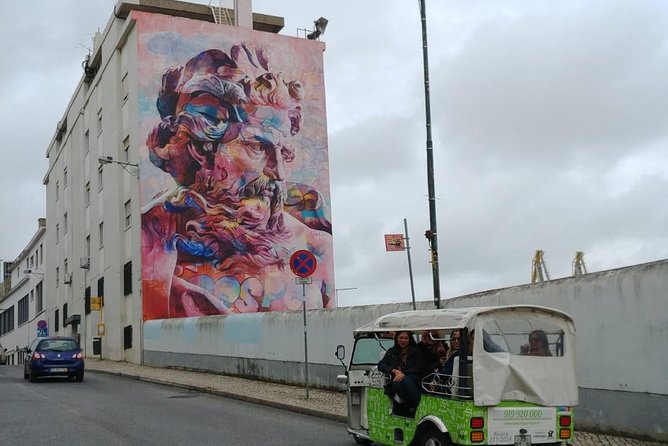
Your first hit is the sidewalk of Santa Apolónia, where you find a large sculptural figure layered over what feels like endless tagging. The artists are Pichi&Avo, a Spanish duo known for combining classic art methods with graffiti energy. The mural is linked to the exhibition Versus at the Underdogs Gallery, which helps explain the idea: this is not just street decoration, it is street dialogue.
What I like about this kind of starting stop is how it sets your eyes for the rest of the day. You start noticing textures fast, like the balance between coarse brushwork and careful drawing. And because it is on the side of a building, you get a sense of scale you cannot get from a quick photo.
Practical tip: take a moment to stand a little farther back first, then walk closer. From far away, you read the full figure. Up close, you catch the brush logic that makes the whole thing work.




Santa Clara Field: André Saraiva’s 53,000 tiles
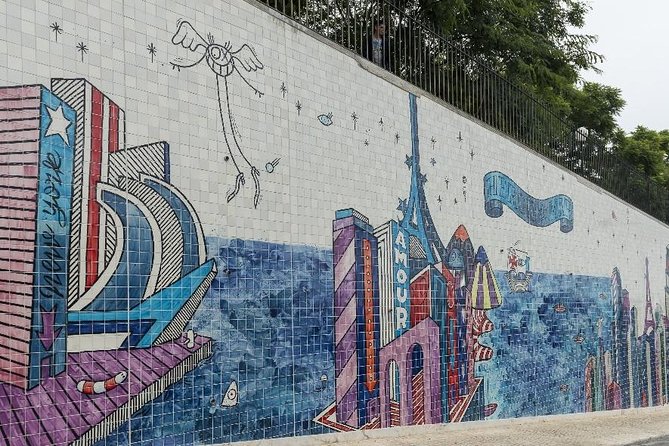
Santa Clara Field is where the tour switches gears from street-paint intensity to tile craft. You are looking at a huge wall mural by André Saraiva that covers about 170 meters of wall, around 1000 m2, made with roughly 53,000 tiles.
That number is the kind of detail that makes you slow down. Even if you think you already understand murals, tile work changes the experience. Tiles force the image to be built in sections, and they catch light differently across the day. On a calm day, it can look almost architectural, like it belongs to the city’s design language, not just its graffiti scene.
Possible consideration: tile murals are sometimes harder to photograph cleanly if the wall is crowded with angles, bikes, or shadows. Your guide can help you choose the best spot for pictures, but if you are the type who needs perfect compositions, arrive with a little patience.
Vhils in Travessa das Merceeiras, face carved from the street
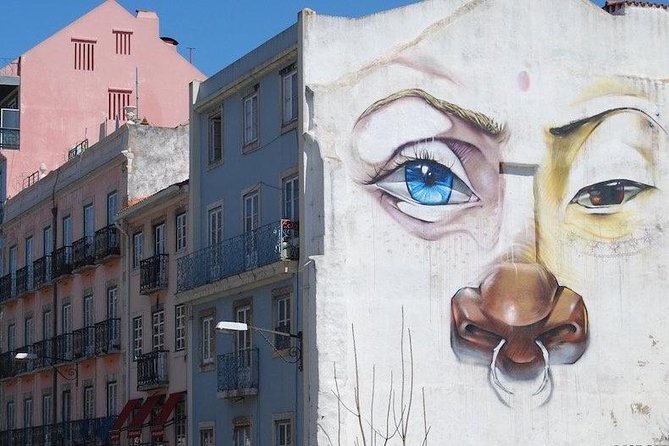
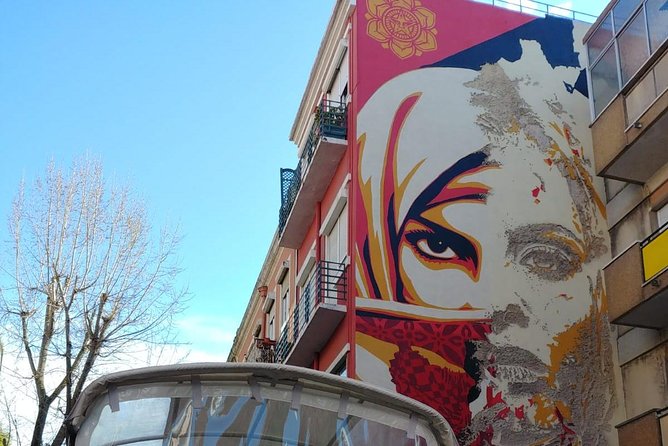
Next is Vhils, real name Alexandre Farto, and the moment feels like the city is sculpting itself. His work is known for carving and eroding surfaces so faces and forms appear through the material. In Travessa das Merceeiras, one of his earlier Lisbon faces is hidden in plain sight.
I like this stop because it changes your thinking about street art. Instead of only adding color, this approach subtracts material, which means the wall’s surface becomes part of the artwork. It also rewards careful looking, because the “face” concept makes you scan longer than you planned.
Practical tip: bring your phone camera ready, but also take your eyes off the screen for a second. These works can look different as you shift your position.
Graça literary portraits and two viewpoint stops
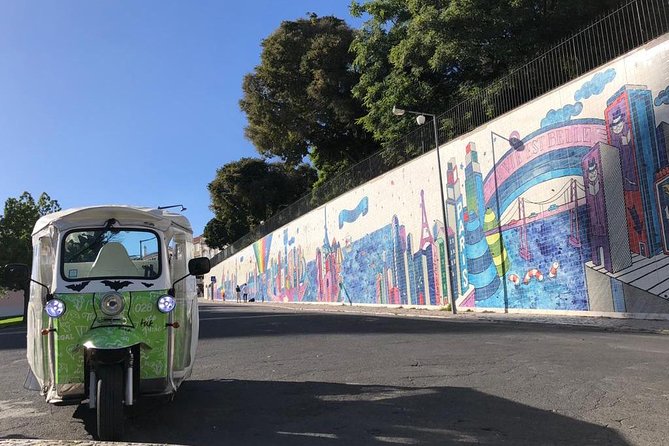
In the Graça area, the art connects to Portuguese literature and specific faces tied to the neighborhood. A group of artists honored figures from national literature who had connections to Graça, using portraits created by other street artists.
You will see Sophia de Mello Breyner portrayed by Eime on Rua Josefa de Óbidos. Nearby, you can also find Natália Correia and Florbela Espanca portrayed in Travessa do Monte in a work by Mariana Dias Coutinho. The best part is the pairing with the viewpoints of Graça and Senhora do Monte, so the tour does not stay stuck at street level.
This is one of those “slow down” zones. When art references people and places, it pulls you toward the meaning, not just the style. And when viewpoints come into play, you get the city back in front of you, with the neighborhoods laid out underneath the murals.
Avenida Fontes Pereira de Melo: Os Gémeos, Blu, and other heavy hitters
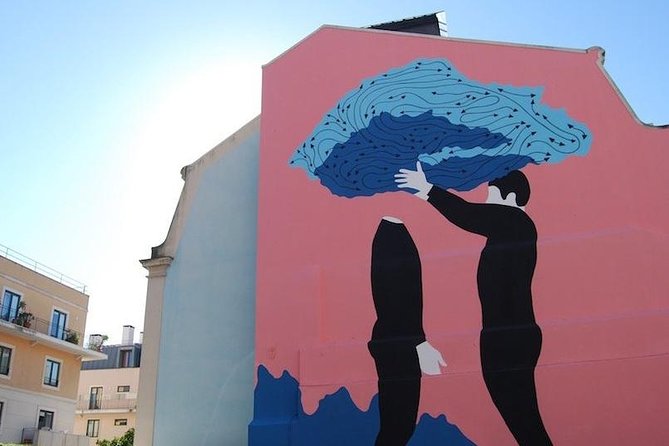
Then you hit Avenida Fontes Pereira de Melo, one of the busiest avenues in the city. The work here is spread across three vacant buildings, which makes the art feel bigger than a single wall. It is international too, with Brazilian Os Gémeos, Italian Blu and Eric Il Cane, plus Spanish Sam3.
There is also an external stamp of recognition tied to this project. The work was considered one of the 10 best in the world by The Guardian. Even if you do not care about rankings, that detail helps you understand the scale of attention this kind of urban art can earn.
Practical consideration: this area is busy by definition, so expect traffic noise and lots of movement around you. The tuk-tuk helps here, because it keeps you from getting trapped trying to cross streets at the wrong moment. If you are serious about photos, your guide’s timing can make or break the shot.
Lx Factory and Bordalo II’s garbage bee
Lx Factory is the creative factory portion of the day, where street art overlaps with shops, workshops, and gallery-like spaces. The setting feels more like a design district than a pure alley mural hunt.
Here, you will find more than a dozen works by well-known names. One standout is Bordalo II, famous for playful pieces made from discarded materials. The example in the route is his huge bee made of garbage, which turns trash into a statement you cannot ignore.
This stop is a good closer because it gives you a different “mode” of art. By now you have seen carved faces, tiles, and layered street pieces, so the factory environment lets you breathe and look longer without feeling like every second must be a new mural.
If you want to shop or snack, this is where you usually can. Food and drinks are not included, but the surrounding area is built for breaks.
The guides: what makes the storytelling land
A street art tour lives or dies on the guide. The names that show up often with this operator include Nuno, Filipe, and Pifas, and the common thread is how they link art to Lisbon’s streets instead of treating murals like random wall stickers.
Filipe’s approach, for example, includes enthusiasm plus practical flexibility. When traffic allows, you can sometimes help decide where the tuk-tuk stops so you can take photos, or the driver can slowly pass while you frame the shot. That kind of real-world timing is a big deal when you are trying to capture big murals and small details in the same day.
Pifas is another name tied to inspiring explanations, with not only art knowledge but also lots of extra talk about the city and how the scenes fit together. Nuno is described as bringing the city to life through the history of the art and the places it touches.
Also, one departure noted extra value from stopping at a viewpoint and a pastelaria. The tour does not include food, but if your guide can work in a short pastry break and a lookout, it makes the whole experience feel more like Lisbon instead of just “art viewing.”
Should you book this Tuk Tuk Lisbon urban-art tour
Book it if you want street art as a guided, efficient route with real context. This is especially smart if you like photos, because the setup is built for short stops and close looking, not just reading plaques. The private guide format also helps if your group has different interests, art lovers and casual explorers can both get something.
Skip it or choose another option if you need a highly mobility-friendly plan. The tour is not recommended for pregnant women or people with reduced mobility, and it has a strict child rule (no children under 7). If you fall into either category, ask about alternatives before paying.
One more deciding factor: this is a 2 to 3 hour commitment. If you only have one short window in Lisbon and you want it to feel modern and specific, this tour hits that target.
If you book, I’d plan your day so you are not rushing into this right after a long travel day. You want enough energy to look closely at faces, tiles, and the fine line between graffiti intensity and careful drawing.
FAQ
How long is the Tuk Tuk Lisbon urban art tour?
It runs about 2 to 3 hours.
What does the tour cost?
The price is $93.73 per person.
Is pickup included?
Yes. Pickup is offered at Lisbon hotels and Airbnbs near the historic centre, in the three cruise terminals of Lisbon, and at nearby restaurants or other places close to the historic centre.
Is this tour private?
Yes. It is a private tour, so only your group participates. The vehicle has a maximum of 6 seats.
Are there age or mobility restrictions?
Children under 7 are not allowed. It is not recommended for pregnant women or people with reduced mobility.
What is included in the price, and what is not?
Included: guided tour, private guide, and private transportation. Not included: food and drinks, and monuments tickets.
Tuk Tuk Runs Around Lisbon We Squeezed Into





Newly added around Lisbon
- Lisbon: Street Art Walk
★ 5.0 · 79 reviews - From Lisbon: Nazare Big Waves and Óbidos Guide Day Trip
★ 4.7 · 79 reviews - Small Group Walking Tour of Belém
★ 4.9 · 80 reviews - Lisbon: Regaleira, Sintra, Cape Rock & Cascais Day Trip
★ 4.6 · 80 reviews - Lisbon: Evening Local Food Crawl with Drink Pairings
★ 4.6 · 80 reviews - From Lisbon: Sintra and Portuguese Coast Private Day Tour
★ 5.0 · 80 reviews - Lisbon: Authentic Fado Show, Dinner and Night Tour
★ 4.6 · 80 reviews - Golden Hour Boat Tour – Sailing by the Monuments with Wine
★ 5.0 · 81 reviews - Hard Rock Cafe Lisbon with Set Lunch or Dinner
★ 4.0 · 81 reviews - Fado Musical Experience with Portuguese Wine & Appetizers
★ 4.5 · 81 reviews
Other boats, other operators: Tuk-Tuks.
 ★ 5.0True 4Hour Private Tuk Tuk Tour: Discover Lisbon with a Local!From $1088,008 reviews
 ★ 4.5Porto: Guided Tour by Tuk-Tuk & Optional Douro River CruiseFrom $205,980 reviews
 ★ 4.9Lisbon: Private Guided Tuk-Tuk Tour with Hotel PickupFrom $1534,552 reviews
 ★ 5.0Private Lisbon Sightseeing Tuk-Tuk Tour: Alfama, Belém & MoreFrom $524,277 reviews
 ★ 5.0Lisbon Highlights: Private Tuk Tuk Tour Adventure SightseeingFrom $843,284 reviews
 ★ 4.5Discover Porto’s Highlights on a 2-Hour Private Electric Tuk TukFrom $481,860 reviews
 ★ 5.0Welcome Lisbon Tour with Local Guide in Private Eco Tuk TukFrom $171,691 reviews
 ★ 4.9Lisbon: Private City Tour by Eco Tuk TukFrom $281,215 reviews
Filed under