
REVIEW · TOURS
Lisbon Revelation Tour
Lisbon starts making sense fast. This small-group walk strings together Lisbon’s key neighborhoods with storytelling from an art historian. You finish with sweeping Miradouro views, and a morning schedule leaves your afternoon open.
I love the way the route guides you from the old power center into the rebuilt city, then up toward viewpoints and churches. I also like the included food stop, choosing between a pastel de nata or a ginjinha.
One thing to plan for: it’s a real walking tour with some elevation and steps, so bring comfy shoes and move at a steady pace.
In This Review
- Key Points Before You Go
- Entering Lisbon Through Terreiro do Paço to Rossio
- Praça do Comércio, Then Baixa, Rossio and Restauradores
- Praça da Figueira and Restoring the Downtown Feel
- Elevador de Santa Justa to the View That Makes It Click
- Largo do Carmo, Chiado and Carmo, and the 1974 Connection
- A Tribute to the Discoveries Epic Poet, and Lisbon’s Bohemian Side
- Igreja de São Roque, Baroque Extravaganza in Short Form
- What’s Included: Pastel de Nata or Ginjinha
- The Guide Factor: How Storytelling Makes Stops Stick
- Price and Time Value for a Morning City Reset
- Weather, Shoes, and Realistic Expectations
- Who This Tour Fits Best
- Should You Book the Lisbon Revelation Tour?
- FAQ
- How long is the Lisbon Revelation Tour?
- What does the tour cost?
- Is the tour offered in English?
- What is included in the tour?
- Where does the tour start and where does it end?
- Does the tour run in bad weather?
- What is the cancellation policy?
Key Points Before You Go
- Small group size (max 16) helps the guide keep a personal rhythm and answer your questions.
- Morning timing (starts 10:00 am) gives you a strong orientation, then time to roam later on your own.
- Art historian-led commentary connects architecture, politics, and Lisbon’s rebuild after the earthquake.
- Landmark mix, not just photos: you pause at squares that matter, plus major viewpoints.
- Included tastings give you a quick local break without hunting for a café.
- Views at the end are the payoff, especially over Castle Hill from Miradouro de São Pedro de Alcântara.
Still weighing up the options? These are other Lisbon trips our reviewers have actually been on.
- Lisbon City Center Tour – The Unmissable Lisbon★ 5.0 · 22,234 reviews
- Lisbon: Sintra, Pena, Regaleira, Cabo da Roca & Cascais★ 4.7 · 19,656 reviews
- Lisbon: Jerónimos Monastery Entrance Ticket★ 4.1 · 14,164 reviews
- Lisbon: History, Stories and Lifestyle Walking Tour★ 4.8 · 10,902 reviews
Entering Lisbon Through Terreiro do Paço to Rossio
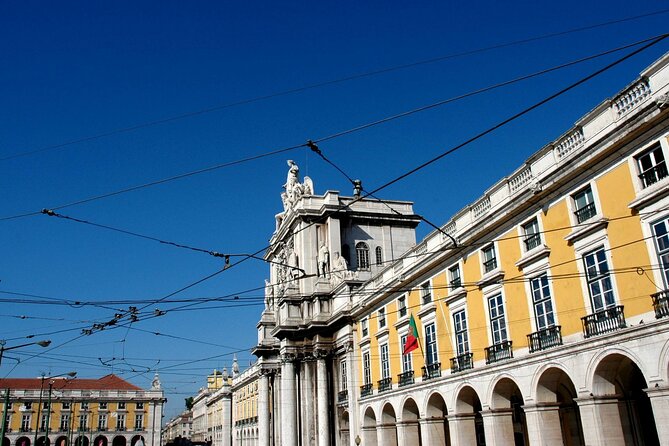
You’re not just “touring Lisbon” here. You’re getting a guided mental map. The meeting point is at Cervejaria Antártida Lisboa, right by Praça do Comércio (Terreiro do Paço), and you start at 10:00 am. That spot is the perfect launch pad because it anchors Lisbon’s story in power, trade, and the sea.
From your first steps, your guide works at a pace that feels human. The idea is simple: you’ll see where Lisbon held authority, then you’ll follow how the city reshaped itself in the centuries that followed. Guides such as Filipa and José come up often in recent experiences, and the shared theme is clear, they don’t rattle off facts, they turn them into reasons you’ll recognize later as you wander.
You’ll also get an early reminder that Lisbon is hills, stairs, and turns. It’s manageable, but you should dress for walking and expect some climbing.
Praça do Comércio, Then Baixa, Rossio and Restauradores
Stop 1 is Praca do Comercio (Terreiro do Paco). It’s framed as the everlasting center of power, and that makes sense the moment you’re there. This is the part of Lisbon where you can feel the city’s “working core,” built around the idea of movement: ships, commerce, and the people who ran it.
You’ll spend about 20 minutes here. Even if you’re only looking at the open square, your guide will point you toward what to notice, the logic of the layout, the civic role of the space, and why Lisbon’s later growth had to fit around this kind of anchor.
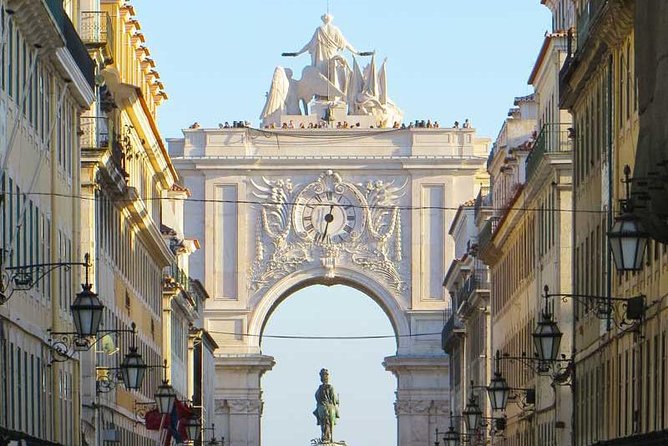
Then you move into Baixa, Rossio & Restauradores, about 30 minutes. This area is introduced as the new city built after the earthquake. That phrase matters because it tells you how to see the streets. Instead of treating Baixa as just “pretty downtown,” you start noticing design choices that came out of rebuilding, the grid-like structure, and the way the city’s center was re-planned for flow and resilience.
Your time around Rossio is also a good moment for questions. Guides often use this stretch to connect big history to everyday details, like why certain buildings face the way they do and how public squares become the stage for city life.
Praça da Figueira and Restoring the Downtown Feel
Next comes Praca da Figueira. You only linger about 5 minutes, but it’s the kind of stop that keeps the tour from becoming all monuments and no texture. It’s described as Lisbon’s traditional market square, so expect the guide to focus on how this area functioned as a daily hub.
Then you hit Praca dos Restauradores for about 5 minutes, described as the image of an European capital. That’s a useful way to look at it. Instead of treating it like a random junction, think of it as a statement space, designed to project a certain civic identity, with Lisbon aspiring to a broader European style.
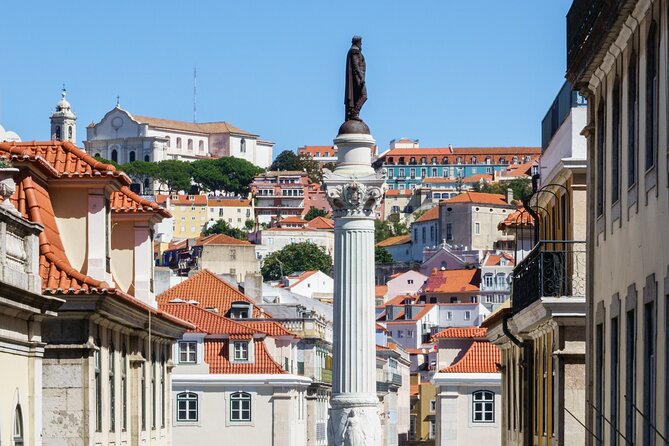
After that, Praca Dom Pedro IV (about 10 minutes) is framed as the heart of downtown. This is where the walking tour starts to feel like a neighborhood rhythm. You’re surrounded by activity, street life, and the kind of urban scale that helps you understand why Lisbon works well for wandering once you’re oriented.
Elevador de Santa Justa to the View That Makes It Click
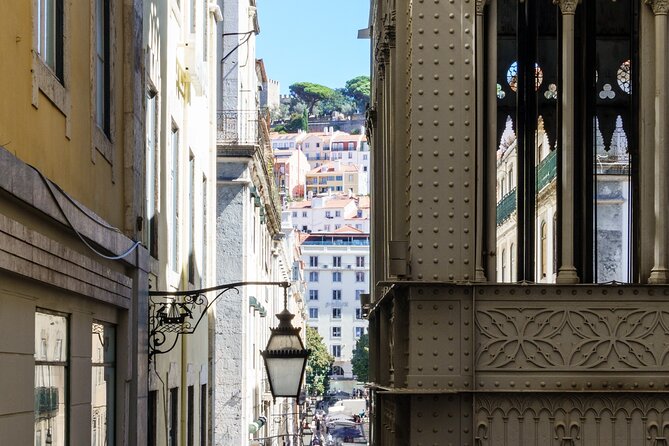
Now for the practical payoff. You stop at Elevador de Santa Justa for about 10 minutes. You’re not just admiring a landmark. You’re getting a lesson in vertical Lisbon, how the city solves elevation, and why the streets feel layered rather than flat.
From here, it’s easier to understand why Lisbon’s viewpoints matter so much. Even if you don’t ride the elevator, you’ll see how the city’s design connects different elevations and neighborhoods.
And then you land at Miradouro São Pedro de Alcântara for about 10 minutes, with a breathtaking view over Castle Hill. This end point is not a random photo stop. It’s the moment where the route makes sense. When you look out over Lisbon’s rooftops and the hills beyond, you can see the logic you’ve been learning on foot.
Tip for the viewpoint: arrive ready to slow down. This is your last stretch, and the guide’s job shifts from storytelling to helping you see what you just walked through.


Largo do Carmo, Chiado and Carmo, and the 1974 Connection
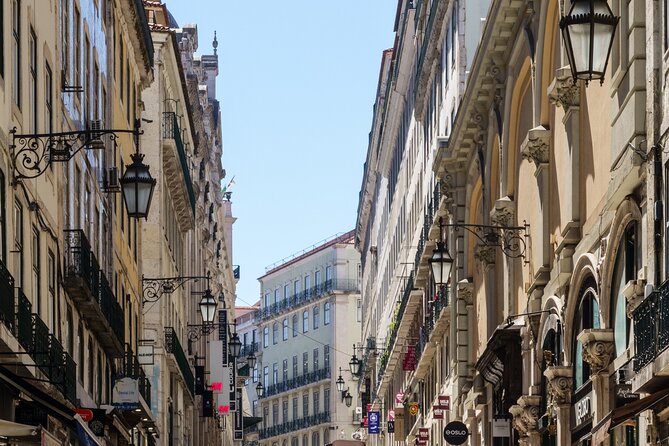
Stop 7 is Largo do Carmo, for about 5 minutes. It’s described as the setting for the democratic revolution of 1974. That’s one of those details that turns a square into a real time capsule. You’ll likely notice how the space is used and framed, and how the city remembers political turning points in everyday places.
Then you move into Chiado & Carmo, about 10 minutes. This stop highlights the city’s only Gothic monument. Whether you’re into architecture or not, this is where Lisbon stops feeling like a “city of postcards” and becomes a city of styles and layers. Your guide’s commentary helps you understand what you’re seeing and why it’s unusual here.
This is also a good zone to catch your breath. The tour rhythm keeps moving, but the stops are short enough that you can reset your energy, grab a sip of water, and keep the climb manageable.
A Tribute to the Discoveries Epic Poet, and Lisbon’s Bohemian Side
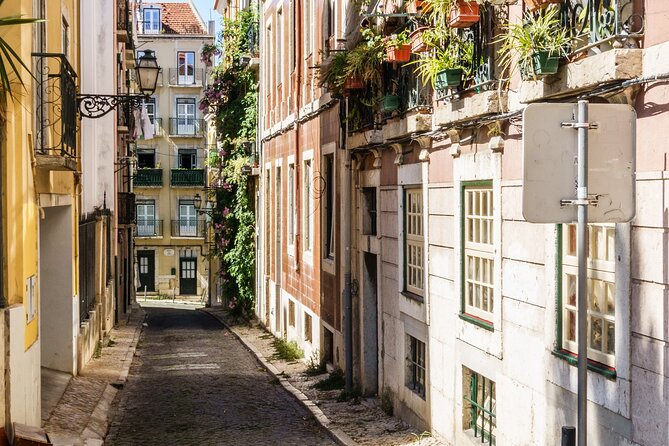
Midway through the second half, there’s a tribute to the Discoveries epic poet, plus a stop that’s described as the lively bohemian district. The point of these moments is thematic, not just scenic. You’re seeing Lisbon not only as a set of monuments, but as a city that still talks to its past through culture, street life, and public memory.
This is also where the tour becomes less about “facts” and more about flavor. If you pay attention to how neighborhoods feel different as you move, you’ll get something practical: the ability to choose where you want to spend time later.
For example, after this kind of walk, you’re usually better at picking whether to return to a polished commercial street, wander into artsy lanes, or seek out viewpoint shortcuts.
Igreja de São Roque, Baroque Extravaganza in Short Form
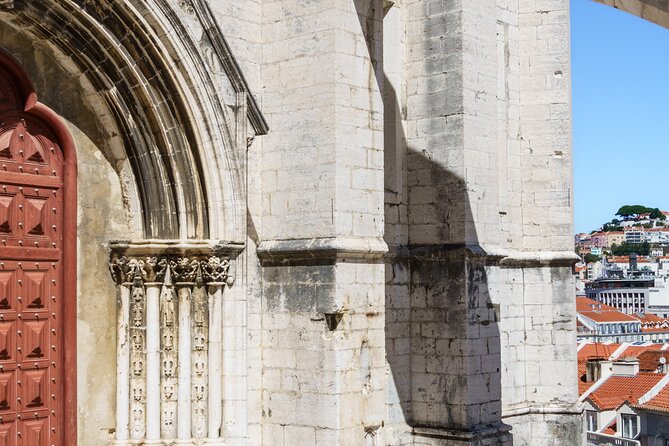
You’ll stop at Igreja de Sao Roque for about 10 minutes, described as a Baroque extravaganza. This is one of the strongest “wow” moments on the tour because Baroque is visual storytelling. It isn’t subtle.
Even in a short stop, your guide can help you look beyond surface decoration. You’ll be primed to notice how Baroque uses drama: contrast, detail, and a kind of theatrical energy. It’s the kind of church stop that works even if you’re not a big church person. The commentary makes it easier to appreciate what you’re seeing quickly.
What’s Included: Pastel de Nata or Ginjinha
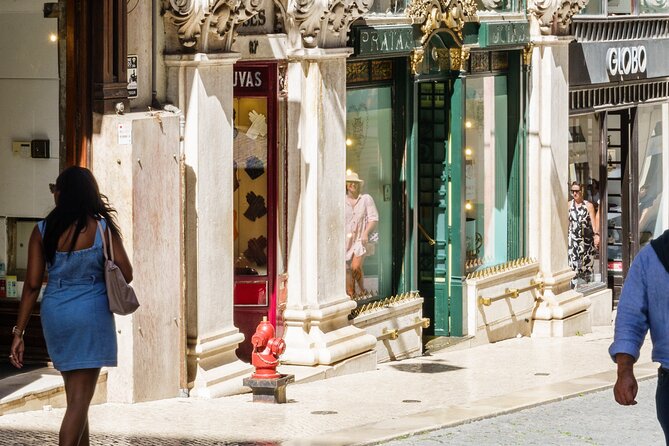
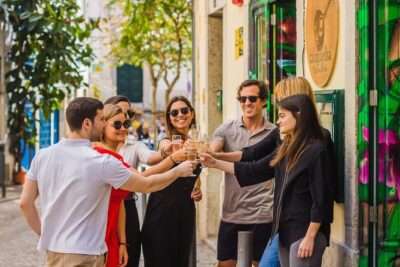
The included food tasting is simple, local, and fast. You’ll get either a pastel de nata (cream custard tart) or a ginjinha (brand cherry liquor). This is one of those “small inclusion” items that turns the tour into a full experience. It breaks the walking rhythm without turning the afternoon into a food quest.
If you’re sensitive to alcohol, choose the pastel de nata. If you’re curious and enjoy Portugal’s flavors, ginjinha is a fun way to taste something that feels like Lisbon identity, not just dessert.
Either way, it also helps you avoid the common problem on walking tours: by the time you find a café, you’re tired and everything tastes average. This tasting happens while you still feel in motion.
The Guide Factor: How Storytelling Makes Stops Stick
This tour leans heavily on a strong guide, and the best part is that the guide’s style affects your whole day. In recent experiences, guides such as Philippa, Alex, Hugo, Mia, Filipa, and José are repeatedly praised for being attentive, sharing lots of historical links, and keeping the pace right.
What that means for you in plain terms:
- You’ll get explanations that connect places, not isolated trivia.
- You’ll likely feel invited to ask questions, especially during the longer downtown stretches.
- The guide can tailor what they highlight depending on your interests, at least in the moment.
The tour’s design also helps. Stops are spaced to create momentum: quick square moments, then longer anchor areas where you can hear the story behind what you’re seeing.
Price and Time Value for a Morning City Reset
At $30.25 per person for about 3 to 4 hours, this is priced like an efficient city primer. You’re paying for three things: a guided route, commentary, and the tasting. The big value is that you’re spending a morning learning how Lisbon is structured, so your later self-guided exploring is less random and more satisfying.
Also, the tour runs with English commentary and caps at 16 travelers. That matters because on a larger group walk, the guide’s attention gets diluted. Here, the pacing and question time feel more workable.
If you’re visiting Lisbon for the first time, I’d treat this as your orientation backbone. Then go deeper later, not during the tour.
Weather, Shoes, and Realistic Expectations
The tour operates in all weather, so plan for it. That means you should bring a light layer or rain protection and accept that the streets might be slick. Also, because you’re moving through Lisbon on foot, you’ll want water and proper walking shoes. The guide might keep stops short, but you’ll still cover plenty of ground.
Moderate physical fitness is recommended, and the route includes hills and steps. It’s not presented as a rugged hike, but it is not a flat stroll either. If you’re unsure, go slow, ask the guide when you need a breather, and keep your pace steady.
Who This Tour Fits Best
This is a great fit if:
- You want a first-time orientation that shows Lisbon’s key neighborhoods in a few hours.
- You enjoy history when it’s tied to visible places.
- You like short stops with context rather than a long museum day.
- You want a reliable morning plan that leaves your afternoon free.
It may be less ideal if:
- You need a fully flat route with minimal walking.
- You dislike guided tours and prefer total freedom from the start.
Should You Book the Lisbon Revelation Tour?
If you’re curious about how Lisbon grew, rebuilt, and reinvented itself, I think it’s a smart way to start. The route hits the essentials without dragging. The included tasting is a nice bonus, and the finish at Miradouro São Pedro de Alcântara is exactly where the city’s geography stops being abstract.
Book it if you want to get your bearings fast and turn later wandering into something that feels informed. Skip it only if you know you’ll refuse hills, or if you’re already comfortable navigating Lisbon and don’t need a structured introduction.
FAQ
How long is the Lisbon Revelation Tour?
It runs for about 3 to 4 hours.
What does the tour cost?
The price is $30.25 per person.
Is the tour offered in English?
Yes, it is offered in English.
What is included in the tour?
You get a professional art historian guide and a food tasting, choosing either pastel de nata or ginjinha.
Where does the tour start and where does it end?
The tour starts at Cervejaria Antártida Lisboa by Praça do Comércio (Terreiro do Paço) and ends at Miradouro de São Pedro de Alcântara.
Does the tour run in bad weather?
Yes, it operates in all weather conditions, so dress appropriately.
What is the cancellation policy?
You can cancel for a full refund if you do it at least 24 hours in advance of the experience start time. If you cancel less than 24 hours before, the amount you paid will not be refunded.
Other Days Out Around Lisbon





Newly added around Lisbon
- Lisbon: Street Art Walk
★ 5.0 · 79 reviews - From Lisbon: Nazare Big Waves and Óbidos Guide Day Trip
★ 4.7 · 79 reviews - Small Group Walking Tour of Belém
★ 4.9 · 80 reviews - Lisbon: Regaleira, Sintra, Cape Rock & Cascais Day Trip
★ 4.6 · 80 reviews - Lisbon: Evening Local Food Crawl with Drink Pairings
★ 4.6 · 80 reviews - From Lisbon: Sintra and Portuguese Coast Private Day Tour
★ 5.0 · 80 reviews - Lisbon: Authentic Fado Show, Dinner and Night Tour
★ 4.6 · 80 reviews - Golden Hour Boat Tour – Sailing by the Monuments with Wine
★ 5.0 · 81 reviews - Hard Rock Cafe Lisbon with Set Lunch or Dinner
★ 4.0 · 81 reviews - Fado Musical Experience with Portuguese Wine & Appetizers
★ 4.5 · 81 reviews
Other boats, other operators: Tours.
 ★ 5.0The Unvanquished Tour in Porto City CenterFrom $326,497 reviews
 ★ 5.0Lisbon City Center Tour – The Unmissable LisbonFrom $322,234 reviews
 ★ 4.7From Porto: Douro Valley w/ Boat Tour, Wine Tasting & LunchFrom $8219,061 reviews
 ★ 4.8Lisbon: History, Stories and Lifestyle Walking TourFrom $2910,902 reviews
 ★ 4.8Portimão: Benagil Caves Speed Boat Tour with Sunset OptionFrom $239,329 reviews
 ★ 5.0True 4Hour Private Tuk Tuk Tour: Discover Lisbon with a Local!From $1088,008 reviews
 ★ 4.8Portimão: Benagil Sea Caves Speedboat Adventure TourFrom $206,546 reviews
 ★ 5.0Winner 2025 Undiscovered Lisbon Food & Wine Tour by Eating EuropeFrom $1256,390 reviews