
REVIEW · PRIVATE
Tour of Lisbon in a Private Tour
Lisbon from a private guide feels different fast. You get the key sights plus the why behind them, paced for your day.
I like this setup for undivided guide attention. When the streets twist or the timing gets tricky, your guide keeps the day smooth and explains what you are seeing in plain language.
I also like the mix of big views and real neighborhoods. You spend time looking out from miradouros, then you walk Alfama’s old lanes, not just stand in front of monuments. One drawback to plan for: this is an all-day route with hills and stairs, so comfortable shoes and a slow, steady pace help.
In This Review
- What Makes This Lisbon Private Tour Special
- Santa Justa First, Because Lisbon Hits Hard When You Look Down
- Elevador de Santa Justa: The Ride, the Architecture, the Big View
- Portas do Sol: A Short Stop That Feels Like a Real Break
- Alfama: How a Local Guide Turns a Maze Into a Story
- Senhora do Monte and St. Anthony: More Viewpoints, Less Crowded Feeling
- Lisbon Cathedral and the Rebuilt Baixa: The City After 1755
- Praça do Comércio and Lisbon’s Shopping Spine
- Almada’s Christ the King: The Lisbon View You Will Remember
- Belém Day, Done in the Right Order: Discoveries, Jerónimos, Torre
- Padrao dos Descobrimentos
- Jerónimos Monastery Church
- Torre de Belém
- Price and Value: Why Private Can Be Smart at This Price Point
- Timing, Pace, and Comfort Tips for a Smooth Day
- Guides You Might Be Lucky to Get, and Why That Matters
- Should You Book This Lisbon Private Tour?
- FAQ
- Is pickup included, and where does it happen?
- What language is the tour offered in?
- How long is the Lisbon private tour?
- Are tickets included for the attractions on the route?
- Is lunch included?
- Can I cancel for a full refund?
What Makes This Lisbon Private Tour Special
- Hotel pickup and drop-off with an air-conditioned vehicle, including cruise port pickup
- Iconic Santa Justa Elevator with the ride and ticket included
- Miradouro breaks built in, including Portas do Sol for coffee and tram 28 views
- A guide who adapts, with multiple past guides praised for fixing timing when conditions change
- A strong highlights chain from Baixa to Belem, without the stress of navigating alone
- Major monuments handled smartly, like Jerónimos Church visit and Christ the King viewpoints
More private, just-your-group bookings in Lisbon we have reviewed
- True 4Hour Private Tuk Tuk Tour: Discover Lisbon with a Local!★ 5.0 · 8,008 reviews
- Lisbon: Private Guided Tuk-Tuk Tour with Hotel Pickup★ 4.9 · 4,552 reviews
- Private Lisbon Sightseeing Tuk-Tuk Tour: Alfama, Belém & More★ 5.0 · 4,277 reviews
- Lisbon Highlights: Private Tuk Tuk Tour Adventure Sightseeing★ 5.0 · 3,284 reviews
Santa Justa First, Because Lisbon Hits Hard When You Look Down
I love starting Lisbon with a height advantage. It sets the tone immediately, because Lisbon is all about angles, viewpoints, and those steep streets that seem to fold into each other.
This day begins with the Santa Justa area, and it is a good choice. You are not yet tired, crowds are usually lower, and your guide can quickly explain how the city’s layout and elevation shape everything from views to neighborhoods.
Also, it is private, so you can move at a comfortable pace. If you need a breather on the walk, your guide will not rush you like a bus tour does.
Elevador de Santa Justa: The Ride, the Architecture, the Big View
This is one of Lisbon’s most recognizable historic elevators, and it earns its fame. The structure is neo-Gothic, designed by Mesnier du Ponsard, and originally called Ascensor Ouro-Carmo. It also connects Rua do Ouro to Largo do Carmo, so it is not just a photo stop, it is a city function.
What I enjoy most is the contrast. The view from the top feels like a reward for a ride that is both elegant and slightly old-world. The wooden cabins, decorated with brass details, make the ascent feel like you are traveling through time.
At the top, you get a view across Baixa, the Castle area, the Tagus River, and even the ruins of Igreja do Convento do Carmo. That mix of river, neighborhoods, and history is why this stop matters.
Practical note: the time window is short, about 20 minutes, but the payoff is high.
Portas do Sol: A Short Stop That Feels Like a Real Break
Portas do Sol is one of those miradouros where the place itself does half the work. It sits well on the route, so you can pause without losing your momentum.
From here, you look across the eastern front of Alfama and out toward the Tagus. The view also frames domes and different church architecture, including Santo Estêvão, São Miguel, and São Vicente de Fora.
What makes it feel more than a viewpoint is what is right there. There is a kiosk where you can grab an authentic Portuguese coffee, and you can often catch tram 28 passing near the stop in front. Even the statue of Saint Vincent is part of the viewpoint experience.
This is a quick stop, about 5 minutes, and it works perfectly as a reset before Alfama.
Alfama: How a Local Guide Turns a Maze Into a Story
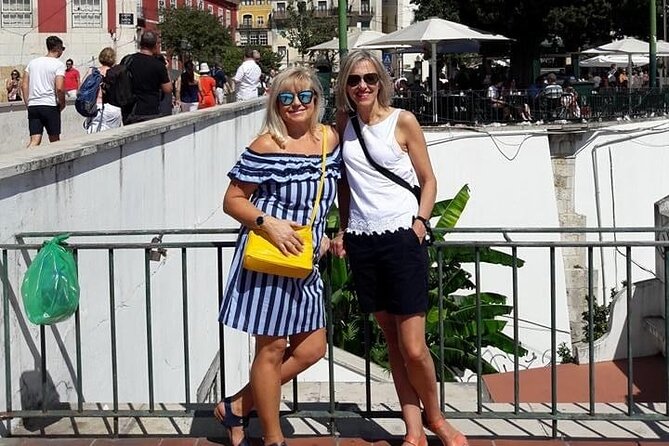
Alfama is the oldest neighborhood in Lisbon, and one of the oldest in Europe in the sense that it still carries ancient roots in everyday life. It was once a Jewish quarter and a fishing community, and it survived the 1755 earthquake because the area sits on the highest hill foundations.
This is the part of Lisbon that can overwhelm you if you go solo. The streets are narrow, the alleys are layered, and there are lots of angles to choose from. With a guide, you get help deciding where to look and what to notice.
You will get the sensory version of Lisbon here. Think clotheslines on balconies, fish grilling near corners, fado drifting from inside restaurants, and tile panels that you might otherwise miss while scanning for major landmarks.
The goal is not to check off a list. It is to feel the neighborhood rhythm. Then, when you move downhill toward the river side, Lisbon shifts into the more modern world again.
This stop runs about 1 hour, and since admission is not included, it is worth asking your guide what, if anything, you plan to enter beyond just walking and viewing.


Senhora do Monte and St. Anthony: More Viewpoints, Less Crowded Feeling
After Alfama, the day keeps climbing and then pauses again. Miradouro da Senhora do Monte is a prime example of that. It used to be a quieter secret. Now it is popular, especially at sunset, but it still feels relaxed if you time it well.
What you get is a panoramic view of Lisbon from one of the higher points. The viewpoint’s name connects to a Virgin Mary image, and behind it there is a small 18th-century chapel that is almost always closed. There is also an old legend tied to the stone chair inside.
Even if you do not plan around the legend, the view is the point. It is also convenient because several monuments can be identified using a tile panel map. If you like orientation, you will appreciate this.
This stop is about 15 minutes. It includes free admission, so you are not racing against a ticket window.
Then you move to the Church of St. Anthony, also known as Santo António. It is believed to be on the site of Saint Anthony’s birth house, next to the old Porta do Mar wall area. There is a small museum dedicated to him nearby.
This one is short, about 15 minutes, but it adds a religious and historical anchor after the viewpoint.
Lisbon Cathedral and the Rebuilt Baixa: The City After 1755

Now you get into two big ideas at once: Lisbon’s medieval foundations and its modern planning after disaster.
Lisbon Cathedral is the seat of the Patriarchate of Lisbon and the Cathedral parish. Construction began in the second half of the 12th century after D. Afonso Henriques conquered the city from the Moors. Today you see a mix of architectural styles, and it has been classified as a National Monument since 1910.
Admission is free here, so it is an easy add without extra cost.
From there you get a sense of Baixa, the downtown district that was completely rebuilt after the 1755 earthquake. That quake was the largest ever recorded in Europe, and it led to new neoclassical planning and large-scale earthquake-resistant construction.
Your guide will help you connect design choices to daily life. Streets were shaped and measured with intent, and many were named after trades and artisans from that era. Later, in the 20th century, banks and offices occupied many buildings, pushing residents to Avenidas Novas, and leaving some buildings abandoned. More recently, the area has been reborn as a commercial and tourist center.
It is also pedestrian-friendly in many stretches, and it ties together monumental squares like Rossio and Commerce Square.
Praça do Comércio and Lisbon’s Shopping Spine
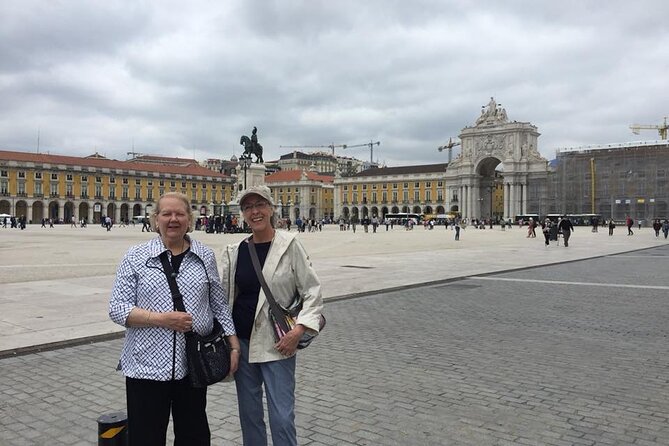
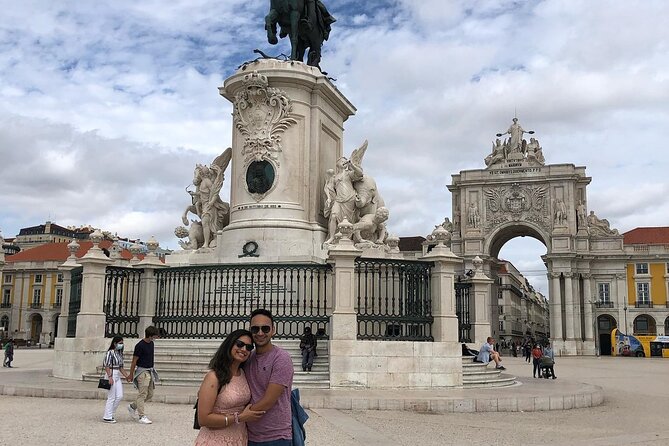
Commerce Square, Praça do Comércio, is Lisbon’s main square. It is built where the old Royal Palace stood before the earthquake of 1755. The southern side opens toward the Tagus River, giving you that classic Lisbon waterfront feel.
Three sides are lined with yellow buildings and arcades, which make the square feel both bright and sheltered at the same time. Historically, it was the “door” to Lisbon because ships unloaded goods directly here.
After you soak in the square, the route continues along Lisbon’s grand shopping avenue, often compared to the Parisian Champs-Elysées in vibe. It is a tree-lined stretch with Portuguese cobblestones between Restauradores and Marquês de Pombal. This is where the luxury shops cluster, with the area continuing down from Rua Castilho.
You also pass theaters and older architecture, though some mid-20th-century rebuilding changed the mix. If you like architecture, this is a good walking window.
There is also a useful idea attached to this stretch. If you climb the eastern side with the Lavra Elevator, you reach the old parish of Pena and the calmer, more local feel. Your guide can also point out the Miradouro do Torel viewpoint in that area.
Almada’s Christ the King: The Lisbon View You Will Remember
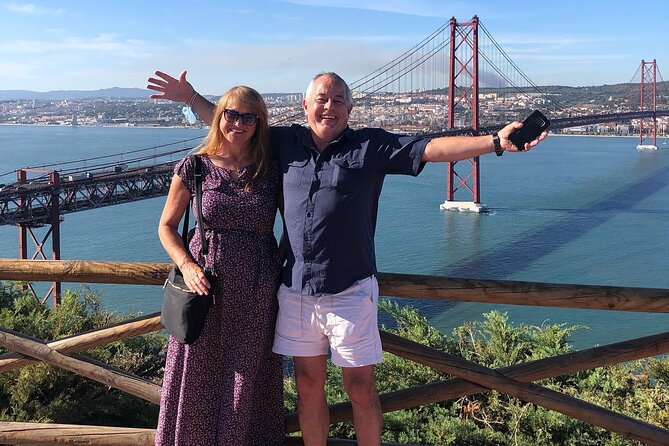
Then comes one of the best viewpoint payoff moments. The Santuario Nacional de Cristo Rei sits about 133 meters above the Tagus River and features a 75-meter portico with a statue rising another 28 meters, open arms facing Lisbon.
This is the kind of viewpoint that gives you context. You are high enough to see across the capital and spot the 25th of April Bridge. It is also a major attraction in Almada, and the structure is one of the tallest in Portugal.
The stop is about 30 minutes, and it is free. That makes it a strong value moment in the day, because so many other paid attractions in Lisbon do not give this kind of wide-angle city map feeling.
Belém Day, Done in the Right Order: Discoveries, Jerónimos, Torre
After Christ the King, the route settles into the Belém highlights cluster, and it makes sense. These sights share a big theme, Portugal’s Age of Discoveries, plus a strong riverfront identity.
Padrao dos Descobrimentos
You get the Monument to the Discoveries, designed to connect Portuguese overseas expansion to Prince Henry the Navigator. A stylized caravel is shown carrying Prince Henry and 32 figures, including navigators, cartographers, warriors, colonizers, evangelizers, chroniclers, and artists.
The mast is oriented north-south, and the monument includes Portuguese shields with five quinas, castles, and fleurs-de-lis. Curved triangular structures give the illusion of billowing sails.
This is about 15 minutes and free. It is a good “history anchor” before you enter the deeper sacred and architectural stops.
Jerónimos Monastery Church
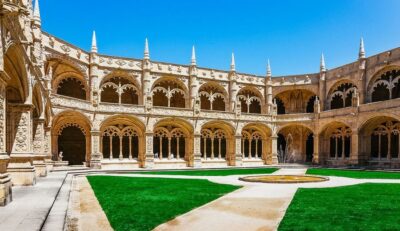
At Jerónimos, you visit only the monastery church. That is important because it keeps the day flowing and still gives you the main impact.
The church is where Vasco da Gama is buried, and you see extraordinary stonework in the era when West and East connections mattered to Portugal’s identity. The route focuses on the church, so do not expect time for everything else.
This stop is about 20 minutes and free.
Torre de Belém
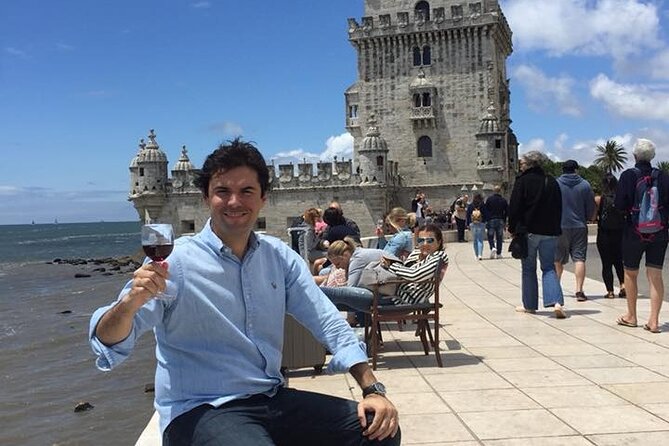
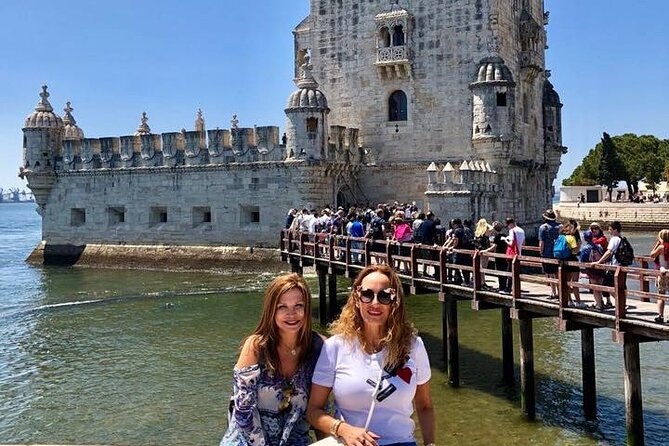
Then the day finishes with the Torre de Belém. It is one of Lisbon’s most recognizable Age of Discoveries landmarks, shaped like a small castle that feels almost fairy tale-like. It is a World Heritage Site.
Your stop here is about 15 minutes and free, and the goal is a panoramic feel rather than deep museum time.
If you like photos, this is your chance to capture Belém’s silhouette.
Price and Value: Why Private Can Be Smart at This Price Point
At $118.56 per person for about 8 hours, this is not a budget tour. But it also is not trying to be one.
You are paying for a private guide, private transport, and hotel pickup and drop-off, plus WiFi on board and required insurance coverage. That combination matters because Lisbon is not easy to navigate comfortably without time loss. Hills, street layouts, and changing conditions can turn a “simple” self-guided day into a stressful one.
You are also buying time efficiency. This route hits major sights across multiple districts: downtown, Alfama, miradouros, and then Belém. With a guide, you get context fast, plus the small adjustments that save the day when roads change or crowds swell.
One more value point: the guide tips you for the rest of Lisbon. In a city like this, those recommendations are often more useful than another photo stop.
Also, the tour is booked well in advance, meaning it is a popular format. If you wait too long, you might lose the exact time window you want.
Timing, Pace, and Comfort Tips for a Smooth Day
Your start time is 8:30 am. That early push is a real advantage because some viewpoints and inner-city areas feel calmer before the late-morning surge.
The day can stretch a bit. Some tours run closer to 9 hours depending on timing and route changes, but the structure keeps it manageable. You get short stops built for walking segments, not a marathon of constant motion.
Still, plan for Lisbon-style terrain. Even if the vehicle handles most of the distance, you will climb, descend, and stand for viewpoints. Wear shoes you can trust on cobblestones and stone steps.
Weather matters too. If you end up with a warm afternoon, prioritize water and slow breaks. Guides often carry practical items like umbrellas, and that kind of preparedness can save your photos and your mood.
Finally, you are in control of your pace. This is private, so you can ask for a slower look at details or a shorter stop if you are tired.
Guides You Might Be Lucky to Get, and Why That Matters
This tour has a strong track record of guides who make Lisbon feel readable. Joao and Anastasia are names that come up often, along with Jorge, Ana, and Anna in different experiences.
What stands out in the guide feedback is not just facts. It is the practical handling of timing. Road closures happen, weather shifts happen, and the best guides reroute without making you feel lost.
If you care about architecture and how a city’s design affects daily life, ask your guide to point out what you should look for at each miradouro and church. The day will feel richer when you have a small checklist in your head.
Should You Book This Lisbon Private Tour?
Book it if you want the best-first-day feeling. If you only have one day, this route gives you a map of Lisbon: viewpoints, historic neighborhoods, rebuilt downtown planning, and the Belém Discoveries core.
Skip it or downscale if you prefer a very relaxed pace and you hate stairs. Lisbon rewards curiosity, but this day requires active mobility across multiple districts.
If you choose to book, do this:
- Bring comfortable shoes and dress for sun and shade shifts.
- Decide before you go what you want most, views or churches, and tell your guide.
- If you care about lunch, plan for it outside the included items, since lunch is not part of the tour.
If you want a day that feels like Lisbon has a pulse, not just a list of stops, this private format is a strong bet.
FAQ
Is pickup included, and where does it happen?
Yes. The tour includes hotel pickup and drop-off, including pickup at the Cruise Port.
What language is the tour offered in?
The tour is offered in English.
How long is the Lisbon private tour?
It is listed at about 8 hours.
Are tickets included for the attractions on the route?
Admission to Elevador de Santa Justa is included. Portas do Sol is free. The other stops listed are shown as having free admission, except Alfama which is not included.
Is lunch included?
No, lunch is not included.
Can I cancel for a full refund?
Yes, you can cancel up to 24 hours in advance for a full refund.
Other Days Out Around Lisbon





Nobody Else Aboard, Other Private Lisbon Bookings




Newly added around Lisbon
- Lisbon: Street Art Walk
★ 5.0 · 79 reviews - From Lisbon: Nazare Big Waves and Óbidos Guide Day Trip
★ 4.7 · 79 reviews - Small Group Walking Tour of Belém
★ 4.9 · 80 reviews - Lisbon: Regaleira, Sintra, Cape Rock & Cascais Day Trip
★ 4.6 · 80 reviews - Lisbon: Evening Local Food Crawl with Drink Pairings
★ 4.6 · 80 reviews - From Lisbon: Sintra and Portuguese Coast Private Day Tour
★ 5.0 · 80 reviews - Lisbon: Authentic Fado Show, Dinner and Night Tour
★ 4.6 · 80 reviews - Golden Hour Boat Tour – Sailing by the Monuments with Wine
★ 5.0 · 81 reviews - Hard Rock Cafe Lisbon with Set Lunch or Dinner
★ 4.0 · 81 reviews - Fado Musical Experience with Portuguese Wine & Appetizers
★ 4.5 · 81 reviews
Other boats, other operators: Private.
 ★ 5.0True 4Hour Private Tuk Tuk Tour: Discover Lisbon with a Local!From $1088,008 reviews
 ★ 4.9Lisbon: Private Guided Tuk-Tuk Tour with Hotel PickupFrom $1534,552 reviews
 ★ 5.0Private Lisbon Sightseeing Tuk-Tuk Tour: Alfama, Belém & MoreFrom $524,277 reviews
 ★ 5.0Lisbon Highlights: Private Tuk Tuk Tour Adventure SightseeingFrom $843,284 reviews
 ★ 4.5Discover Porto’s Highlights on a 2-Hour Private Electric Tuk TukFrom $481,860 reviews
 ★ 5.0Welcome Lisbon Tour with Local Guide in Private Eco Tuk TukFrom $171,691 reviews
 ★ 5.0Sintra Full-Day Private Tour – A Journey through WonderlandFrom $1871,665 reviews
 ★ 5.0Sintra Private Trip from Lisbon Customizable Dreamlike ExperienceFrom $1631,414 reviews