
REVIEW · TOURS
Cork Factory Tour & Cork Shop
Bark becomes bottles, and you can see it. This Faro cork factory tour at Eco-Fábrica de Cortiça turns cork into a hands-on lesson, with standout moments like knife sharpening and lots of chances to ask questions. One heads-up, it is short and can be busy, so if you are sensitive to noise or rain, you may want to sit where you can hear clearly.
The experience runs about 1 hour 10 minutes and starts at 11:30 am. You meet right at the Eco-Cork Factory in Faro (no hotel pickup), tour the Eco-Cork factory and shop, and then it ends back at the same meeting spot.
In This Review
- Cork Factory Tour and Cork Shop Key Highlights
- Eco-Cork Factory Logistics in Faro, Start Time, and What to Expect
- Entering Algarve Rotas at the Eco-Cork Factory
- The Cork Processing Lesson, from Harvesting Concepts to Market-Ready Material
- Live Demonstrations and the Elena Moment You Will Remember
- Hands-On Cork Cutting, and Why It Matters
- The Cork Shop Stop, Buying Advice, and What to Look For
- What This Tour Includes, What It Does Not, and Real-World Value
- Who This Faro Cork Tour Is Best For
- Should You Book the Eco-Cork Cork Factory Tour and Cork Shop?
- FAQ
- What time does the Eco-Cork Factory tour start?
- How long is the Cork Factory Tour and Cork Shop experience?
- Where is the meeting point?
- What is included in the price?
- Is food or drinks provided?
- Is hotel pickup included?
- Is the tour offered in English, and what’s the group size?
- Are there options for kids or service animals?
Cork Factory Tour and Cork Shop Key Highlights
- Eco-Fábrica de Cortiça is your meeting point, so you skip the scramble for hotel pickups
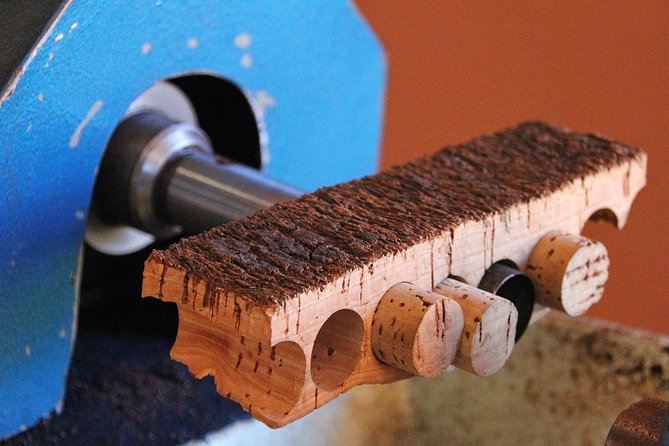
- Live demonstrations show cork trimming, grading, and key processing steps
- Time for questions means you can slow down and understand what you are seeing
- Watch real craft at work, including detailed work with knives
- Cork shopping comes right after the tour, so you can buy while it is fresh in your mind
- Small group feel, with a maximum of 30 travelers
Still weighing up the options? These are other Faro trips our reviewers have actually been on.
- 4 Stops | 3 Islands & Ria Formosa Natural Park – From Faro★ 5.0 · 3,080 reviews
- From Faro: Benagil Cave, Marinha Beach, Algar Seco & More★ 4.7 · 2,027 reviews
- Ria Formosa – Boat trip to the 3 Islands: Armona | Culatra Island | Lighthouse★ 5.0 · 1,872 reviews
- Ria Formosa Natural Park and Islands Boat Cruise from Faro★ 5.0 · 1,314 reviews
Eco-Cork Factory Logistics in Faro, Start Time, and What to Expect
Plan around an easy meet-up. The tour starts at the Eco-Cork Factory, Eco-Fábrica de Cortiça (Francisco Carrusca), Sítio da Mesquita Baixa, 8150-048, Portugal, with a 11:30 am start. You will also finish right back at the same place, which is great when you want to keep your afternoon flexible.
This is not a long coach day. Think of it as a focused stop in your Faro area plans: quick arrival, short factory tour, then shopping time. The duration is listed at about 1 hour 10 minutes, and the schedule stays tight, so it helps to arrive a few minutes early and get your bearings fast, especially if it is your first time in that part of Faro.
A couple practical notes. You get a mobile ticket, the tour is offered in English, and the group is capped at 30 travelers. No hotel pickup or drop-off is included, and food and drinks are not part of the ticket, so if you have a late lunch habit, you will want to plan one before or after.
Entering Algarve Rotas at the Eco-Cork Factory
Your visit centers on a traditional cork factory experience run by Algarve Rotas, with admission included. Even if cork feels like one product to you, this tour frames it as an entire process, from raw bark to market-ready materials.
What I like about meeting the group directly at the factory is that it keeps the experience grounded. You are not wasting time waiting at hotels, and you can just step into the work setting. You also avoid that awkward “where do we go first?” moment that can happen with pickup tours. Here, you are already at the place doing the work.
And yes, it is very much a factory visit. One of the best parts is the pacing: you get an overview, then you move through the working areas while the guide explains what matters and why.
The Cork Processing Lesson, from Harvesting Concepts to Market-Ready Material
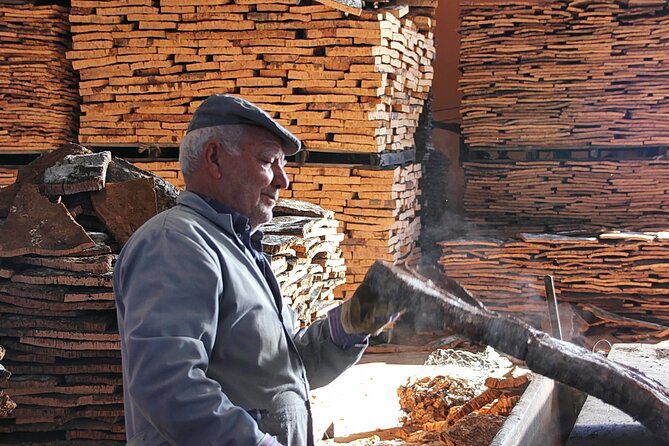
You learn a full chain of ideas. Cork is not just the stopper section of a wine aisle. In the workshop-style explanations, you get the logic behind harvesting the bark, how it is processed, and how it turns into products people rely on.
Here is what you should pay attention to as you walk through:
- How cork bark is prepared for the manufacturing steps
- The role of trimming and grading, and how quality is sorted
- What happens in the treatment stage, including boiling and flattening before sales
You will hear how cork is sorted into different grades, because the grade affects what it can become. That is one of those details that makes cork click. When you understand grading, you stop thinking of cork as a generic material and start seeing it as a range of qualities and uses.
You also get a sense of why cork is so tied to Portugal. Cork production is not a gimmick product, it is a real industry built on skilled labor, careful sorting, and repeatable methods.
One more useful point. Expect a mostly indoor experience. The tour is designed to explain and demonstrate the manufacturing steps in a controlled setting, so it can be a good plan even when the weather is iffy.
Live Demonstrations and the Elena Moment You Will Remember
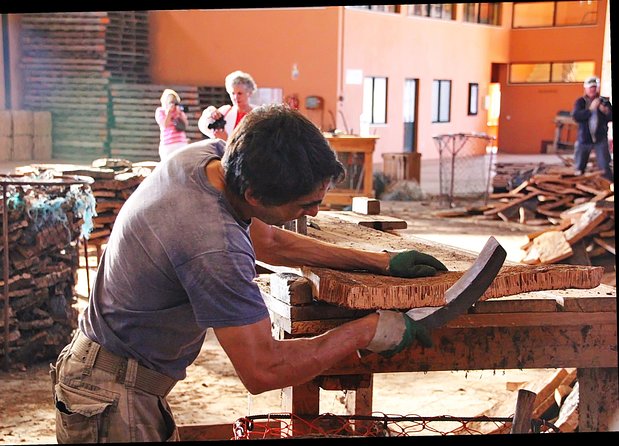
What makes this tour feel more than “watch and walk” is the craft in motion. You get live demonstration time around the techniques used in processing.
The sharp-detail highlights that I found most memorable from the experience are:
- Watching workers cut and grade cork pieces
- Seeing knife sharpening skills explained in a practical way, not as a random fact
- Understanding how trimming affects the final material quality
In at least one of the English-guided sessions, the guide is named Elena, and she is a big part of why the tour lands well. You can hear the explanations clearly, and you get the sense that she is comfortable answering follow-up questions instead of rushing you onward.
If you care about technique, this is where you will start noticing the difference between “cork as a material” and “cork as a manufactured product.” The tiny decisions, like how cork is handled and sorted, are what change the end result.

Hands-On Cork Cutting, and Why It Matters
One of the most fun parts of the day is that you do not only watch. You get the chance to cut some cork yourself. It is typically short, but it is enough to give you a real feel for the material.
Why this matters: when you try even a small task, you gain a tactile understanding of what the guides mean when they talk about quality and grading. Cork is not fragile like some materials, but it is not indestructible either. The way it cuts, how it holds, and how it responds to trimming all connect directly to what makes cork useful.
This is also where the “ask questions” style pays off. If you want to know why a piece is sorted into one category rather than another, this is often the moment to raise it. The tour environment supports that kind of curiosity.
The Cork Shop Stop, Buying Advice, and What to Look For
Shopping time is built into the experience. You visit the Cork Shop at the end, so you can put what you just learned to use when you browse.
A few shopping tips that make the stop more satisfying:
- If you are buying cork for a practical purpose, bring your new grade mindset with you
- If you are shopping for souvenirs, focus on items that clearly show the material connection you just learned about
- Take a quick pass for value before you start filling your bag, since the shop is small and you do not want to miss the best options
The shop experience is often described as small, and that is not a bad thing. It usually means less wandering and more targeted choices. You can expect cute, cork-based items, and in some cases people note that shop pricing felt better than what they saw elsewhere nearby.
Also, this is a smart move for families. A short tour plus a shop means kids have something to look forward to at the end, and you have a chance to turn the lesson into something tangible.
What This Tour Includes, What It Does Not, and Real-World Value
Let’s talk value, because $21.17 is not a “throwaway” price, but this tour also is not trying to be an all-day production.
Included:
- Visit to the Eco-Cork factory (admission ticket included)
- Visit to the Cork Shop
- An English-guided experience with explanations and demonstrations
Not included:
- Food and drinks
- Hotel pickup and drop-off
The real question is whether you get enough learning for the time. With the 1 hour 10 minutes duration, you are getting a tightly focused overview plus demonstrations and time to ask questions. The best value comes if you enjoy small workshops, technical explanations, and seeing how a local industry really works.
If you were expecting a full cork-harvesting field visit, you might find it more “processing-focused” than that. One practical way to frame it: this is the stage where cork turns into products people buy, not necessarily the scenic version of standing in a grove watching bark come off a living tree.
Who This Faro Cork Tour Is Best For
This is a great fit if you like practical travel, short experiences, and learning something tangible. It also tends to work well if you are:
- Curious about how everyday items are made
- Interested in Portugal beyond the big sights
- Traveling with family and want something that holds attention without taking the whole day
It is especially good if you enjoy guided questions and demonstrations. The tour format is designed for interaction, so if you like to ask why something happens, you will likely get more out of it.
If you have very limited mobility or sensory needs, you will want to go in with your expectations set to a factory setting: it is about viewing and understanding processes, not lounging in a museum gallery. The group size stays moderate at up to 30, but crowding can happen depending on the day.
Should You Book the Eco-Cork Cork Factory Tour and Cork Shop?
I would book it if you want a short, meaningful stop in the Faro area where you actually see how cork moves from raw bark concepts to graded, usable material. The combination of live demonstrations, guided explanations (including the sort of craft detail that names like knife sharpening bring), and the ability to cut cork yourself makes it more memorable than a quick photo stop.
You might skip it if you mainly want an outdoor harvest experience or if you know you will struggle with short, indoor sessions when it gets noisy. Also, since food and drinks are not included, make sure you are not starving when you arrive, or you will spend the tour thinking about your lunch instead of cork.
If you want an easy win for your itinerary, this one is simple to plan around: meet at Eco-Fábrica de Cortiça at 11:30 am, enjoy the 1 hour 10 minutes lesson, and then browse the shop while everything is still fresh in your mind.
FAQ
What time does the Eco-Cork Factory tour start?
The start time is listed as 11:30 am.
How long is the Cork Factory Tour and Cork Shop experience?
The duration is approximately 1 hour 10 minutes.
Where is the meeting point?
You meet at the Eco-Cork Factory, Eco-Fábrica de Cortiça, Francisco Carrusca, Sítio da Mesquita Baixa, 8150-048, Portugal.
What is included in the price?
The tour includes a visit to the Eco-Cork factory and a visit to the Cork Shop, with admission ticket included.
Is food or drinks provided?
No, food and drinks are not included.
Is hotel pickup included?
No, hotel pickup and drop-off are not included.
Is the tour offered in English, and what’s the group size?
Yes, it is offered in English. The maximum group size is 30 travelers.
Are there options for kids or service animals?
Child seats are available under request if you inform the provider at booking. Service animals are allowed.
Other Days Out Around Faro



Newly added around Faro
- Tavira City Tuk Tuk Tour – 1h Tavira City Tour
★ 5.0 · 100 reviews - Quad Biking Adventure Tour in Albufeira
★ 5.0 · 100 reviews - Ria Formosa Boat Sunset Islands Tour from Faro
★ 5.0 · 104 reviews - Faro City Tour on Electric Tuk tuks
★ 5.0 · 114 reviews - Faro Airport Private Transfer to Carvoeiro
★ 5.0 · 124 reviews - Eco Boat Tour in the Ria Formosa Lagoon from Faro
★ 4.5 · 129 reviews - 5-hour tour with 3 stops around the islands and beaches of Ria Formosa
★ 5.0 · 130 reviews - 3-Hour Boat Tour in Ria Formosa on Olhão Algarve
★ 5.0 · 142 reviews - Cork Factory Tour & Cork Shop
★ 4.5 · 150 reviews - Islands Tour: Half Day Cruise in Ria Formosa Natural Park
★ 4.5 · 160 reviews
Other boats, other operators: Tours.
 ★ 5.0The Unvanquished Tour in Porto City CenterFrom $326,497 reviews
 ★ 5.0Lisbon City Center Tour – The Unmissable LisbonFrom $322,234 reviews
 ★ 4.7From Porto: Douro Valley w/ Boat Tour, Wine Tasting & LunchFrom $8219,061 reviews
 ★ 4.8Lisbon: History, Stories and Lifestyle Walking TourFrom $2910,902 reviews
 ★ 4.8Portimão: Benagil Caves Speed Boat Tour with Sunset OptionFrom $239,329 reviews
 ★ 5.0True 4Hour Private Tuk Tuk Tour: Discover Lisbon with a Local!From $1088,008 reviews
 ★ 4.8Portimão: Benagil Sea Caves Speedboat Adventure TourFrom $206,546 reviews
 ★ 5.0Winner 2025 Undiscovered Lisbon Food & Wine Tour by Eating EuropeFrom $1256,390 reviews