

REVIEW · ALFAMA AND OLD LISBON WALKS
Alfama Walking Tour Lisbon
Alfama gets under your skin fast. This 2.5-hour walking tour threads through classic Lisbon hills and viewpoints and ends with a satisfying finish at the cathedral, with an expert local guide telling stories as you go. Two things I really like: you get a real sense of neighborhood life, not just photo stops, and the Earthquake-era history adds meaning to the places you see.
The one drawback to plan for is physical and weather. You will be walking up hills, and you will feel it in the heat, so bring sunscreen, a hat, and comfortable shoes.
In This Review
- Key things to know before you go
- A $0.35 Alfama Walk That Still Feels Thoughtful
- Starting at Praça Dom Pedro IV, then threading into Alfama
- Miradouro Portas do Sol: where the hills make sense
- Teatro Nacional Dona Maria II: Lisbon’s grand drama, from the street
- Igreja de São Domingos: going inside makes the stories land
- Castelo de São Jorge: a quick castle hit with ancient context
- Lisbon Cathedral at the finish: a strong, logical ending
- What you actually get: guide stories, legends, and optional treats
- Guides: what to expect from the personalities behind the stories
- Price, group size, and logistics that actually matter
- Who should book this Alfama walking tour
- Should you book this Alfama tour?
Key things to know before you go
- A guide-led story walk that connects viewpoints and churches to Lisbon’s past, including earthquake impacts and destruction
- Alfama viewpoints on the route, with time around Miradouro Portas do Sol for that wide, postcard feel
- Church interior time, including Igreja de S Domingos, not just a quick glance from outside
- A castle stop with deep-time context, tied to São Jorge’s very long timeline of occupation and fortifications
- Small-ish group feel thanks to a max size of 100 people, plus a tour pace that usually gives you time at each stop
Other walks through the old Lisbon quarters we have reviewed in Lisbon
- Alfama Tour in Lisbon Old Town★ 5.0 · 4,936 reviews
- Private Lisbon Sightseeing Tuk-Tuk Tour: Alfama, Belém & More★ 5.0 · 4,277 reviews
- Lisbon: Hills, Alfama, and Mouraria Tour by Electric Bike★ 4.8 · 3,438 reviews
- Best of Lisbon Walking Tour: Rossio, Chiado & Alfama★ 4.9 · 2,700 reviews
A $0.35 Alfama Walk That Still Feels Thoughtful
At $0.35 per person, this tour has the rare vibe of something you can try without stress. You are not paying for a luxury experience, so do not expect buses, private entrances, or fancy extras. What you are getting is the core ingredient that makes a walking tour work: a local guide who can explain what you are looking at while you are still looking at it.
The second value point is time. Around 2 hours 30 minutes is long enough to make Alfama feel like a place, but not so long that you feel stuck by mile 7. Even better, the tour keeps things moving between meaningful stops, so you get variety without the sense of rushing.
The third value point is focus. This is not a tour that just hands you a checklist. The guide talks about the earthquake history and how destruction shaped Lisbon over time, so the city’s older layers feel connected instead of random.
Starting at Praça Dom Pedro IV, then threading into Alfama
You meet at Praça Dom Pedro IV near Rossio, a practical spot because it is well connected. From there, the walk swings through key areas and heads toward the heart of Alfama. That matters, because Alfama’s streets can feel like a maze if you arrive cold. Getting your bearings early makes the whole day easier.
Pace is built into the stops. The tour spends about 10 minutes at the first viewpoint-focused area, then adds time for outside views and inside moments at religious sites. You also finish at Lisbon Cathedral, which gives you a clear end point for rejoining public transit or continuing on your own.
One practical note: plan to bring water or at least be ready for short breaks. The route is not described as flat, and in hot weather you will want those micro-pauses to reset.
Miradouro Portas do Sol: where the hills make sense
A highlight is the stop at Miradouro Portas do Sol. If you have ever wondered why Lisbon is famous for viewpoints, this is where the city’s “up and over” layout stops being abstract. You see how Alfama clings to the slopes and how streets stack above each other.
This viewpoint moment works because it comes after you have started walking. By the time you reach the overlook, you have already walked enough to understand the geography. Then the guide can point out what to watch for, and you can do the simple thing, look around and let it sink in.
If the sun is intense, take the sensible precautions. One guide experience you can learn from: people have specifically called out needing sunscreen and a hat during hot departures. It is still Lisbon, so plan for glare and heat, even if the morning starts nice.
Teatro Nacional Dona Maria II: Lisbon’s grand drama, from the street
The stop at Teatro Nacional Dona Maria II is brief and simple. You see the famous theater from the outside, and the tour uses that moment to help you understand its role in Lisbon’s cultural life.
I like this kind of exterior stop because it does not force you to spend time on formal visits you may or may not want. You get context, then you move on. It also keeps the tour flowing, which is important in Alfama, where detours can eat your schedule fast.
If you are a theater fan, you may want to note this location for later. Even if you do not go inside on this tour, you will now know where to aim your curiosity.
Other Lisbon calcada routes we have followed on foot



Igreja de São Domingos: going inside makes the stories land
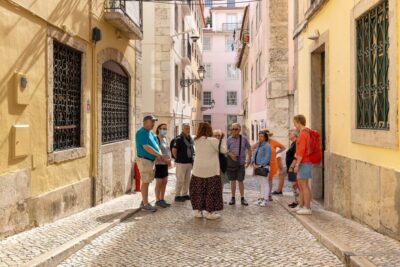
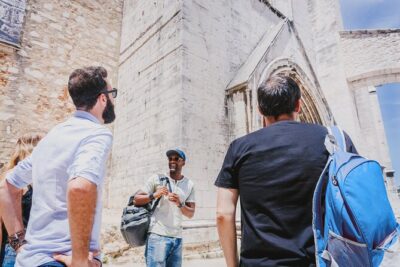
Next comes Igreja de S Domingos, and this is where the tour gives you more than looks. You actually go inside, and that changes everything. Churches are built for slow attention, and when you step inside with a guide, you start noticing details you would miss on a quick walk-by.
This is also tied to the earthquake-and-rebuild theme. Lisbon’s history is not only about kings and dates. It is about how people rebuilt, reshaped, and re-centered their lives after destruction. Hearing those stories while you stand inside a church is one of those “history stops being a lecture” moments.
Two things I find helpful here:
- You get a chance to cool off indoors if you are dealing with heat.
- You get context for why Lisbon’s buildings can feel layered, even when they look like a single structure at first glance.
Castelo de São Jorge: a quick castle hit with ancient context
The tour includes a stop at Castelo de São Jorge. The way the castle is framed helps. You are not just getting the typical viewpoint stamp. You learn that human occupation in this area goes back to at least the 8th century BC, and that the first fortifications date to the 1st century BC.
That matters because it shifts the castle from “pretty walls” to “a strategic hill that kept getting reused.” Lisbon’s topography practically forces that. If you were defending the city, this is the spot.
Time here is around 10 minutes, so you will not do a full roam through every corner of the grounds. Think of it as a strong orientation stop. You get the sense of scale and significance, and then you can decide later if you want a longer castle visit on your own.
Also, be realistic about the climb. Alfama’s walking is part of the charm, but your legs will know it. If you are visiting with limited mobility, you might want to reconsider or plan breaks.
Lisbon Cathedral at the finish: a strong, logical ending
You end at Lisbon Cathedral, at Largo da Sé 1. I like finishing at a major landmark because it helps you move on cleanly after the tour. You are not left wandering back through twisting lanes with sore feet and no plan.
This end point also makes the route feel complete. You start at a central square, step into Alfama’s culture and viewpoint energy, then close with a grand religious site that helps you understand why Lisbon’s spiritual and civic life grew where it did.
If you still have energy after the tour, you are also positioned well to explore nearby areas on your own, rather than needing to “escape” the neighborhood first.
What you actually get: guide stories, legends, and optional treats
Included features are what matter most for your experience:
- An expert local guide
- About 2.5 hours of walking
- Stories and legends, plus history tied to the earthquake and past destructions
- Discounts for other tours in the day and nights
Not included is equally important:
- Alcoholic drinks or a wine or ginjinha tasting
- Transport tickets
Now, here is where it gets practical. Some guides and groups include time for quick stops or optional buys along the way, and reviews have mentioned things like pastel de nata and ginjinha shots as highlights. Since alcohol tasting is listed as not included, treat those as add-ons you can choose, not a guarantee.
If you want the best experience, do two things:
- Bring cash or a card for small food purchases like pastries if you are hungry mid-walk.
- Stay hydrated even if you think you will be fine. Walking uphill and sightseeing together is a classic combo for feeling unexpectedly thirsty.
Guides: what to expect from the personalities behind the stories
One reason this tour gets such strong feedback is the way guides connect history to what you see. Names that have been highlighted include Natalia, Belen, Guilherme, Ana, Vivian, and Valérie.
What those different guides have in common, based on what people praised:
- They are friendly and engaging, not just reading facts.
- They explain history in a way that keeps you from zoning out.
- They can adjust to the group’s rhythm. Some guides have even been noted as working well with a kid around 12 who stayed interested.
That flexibility is a big deal in a walking tour. Some days move slower because people stop to take photos or ask questions. A good guide keeps it lively without making everyone feel dragged.
If you are sensitive to fast speaking, it is worth arriving with a plan: have patience, and feel free to ask to repeat or slow down. You are paying for understanding, not speed.
Price, group size, and logistics that actually matter
Even at a symbolic price like $0.35, you should expect a normal walking-tour reality:
- You will walk.
- You will sometimes wait a few minutes between stops.
- You will likely share the space with others, especially near viewpoints and churches.
The group maximum is 100 travelers, which suggests a decent ceiling but not a private experience. You can still have a good time, but if you hate crowds, go early in the day and keep your expectations realistic.
Also, the tour uses a mobile ticket, and it is offered in English. Those two details make it easier for international visitors to show up and get moving without extra friction.
Weather matters too. The experience requires good weather, so if Lisbon is doing one of its moody days, you might have to reschedule or pivot to another plan.
Who should book this Alfama walking tour
This is a strong fit for:
- First-time Lisbon visitors who want Alfama orientation fast
- People who like stories, legends, and context, not just sightseeing
- Travelers comfortable with hills and short stops
- Families with older kids who can handle a walking pace and will enjoy history talk
It may not be your best choice if:
- You need lots of downtime or step-free access (the route includes hillside walking, and that is not described as optional)
- You are looking for long, museum-style time at major sites
- You want included tastings of alcohol (those are not included)
Should you book this Alfama tour?
If you want a guided walk that helps Alfama make sense, I think it is an easy yes. The combination of viewpoint time, church interior moments, and earthquake-related storytelling is exactly what turns a neighborhood into a place you remember.
Just go in with the right expectations. This is not a “sit down and be driven” tour, and the best results come from showing up ready to walk, ready for sun, and ready to listen. If you do that, you will likely come away with the kind of Lisbon feeling that pictures never fully capture.
Other Days Out Around Lisbon




On Foot Around Lisbon, Other Guided Walks




Alfama and the Old Quarters, Other Walks We Reviewed



Newly added around Lisbon
- Lisbon: Street Art Walk
★ 5.0 · 79 reviews - From Lisbon: Nazare Big Waves and Óbidos Guide Day Trip
★ 4.7 · 79 reviews - Small Group Walking Tour of Belém
★ 4.9 · 80 reviews - Lisbon: Regaleira, Sintra, Cape Rock & Cascais Day Trip
★ 4.6 · 80 reviews - Lisbon: Evening Local Food Crawl with Drink Pairings
★ 4.6 · 80 reviews - From Lisbon: Sintra and Portuguese Coast Private Day Tour
★ 5.0 · 80 reviews - Lisbon: Authentic Fado Show, Dinner and Night Tour
★ 4.6 · 80 reviews - Golden Hour Boat Tour – Sailing by the Monuments with Wine
★ 5.0 · 81 reviews - Hard Rock Cafe Lisbon with Set Lunch or Dinner
★ 4.0 · 81 reviews - Fado Musical Experience with Portuguese Wine & Appetizers
★ 4.5 · 81 reviews
Other boats, other operators: Alfama and Old Lisbon Walks.
 ★ 5.0Private Lisbon Sightseeing Tuk-Tuk Tour: Alfama, Belém & MoreFrom $524,277 reviews
 ★ 4.8Lisbon: Hills, Alfama, and Mouraria Tour by Electric BikeFrom $253,438 reviews
 ★ 4.6Lisbon: Fado in Chiado Live ShowFrom $273,095 reviews
 ★ 4.9Best of Lisbon Walking Tour: Rossio, Chiado & AlfamaFrom $232,700 reviews
 ★ 4.3Lisbon: São Jorge Castle E-Ticket and Audio GuideFrom $302,182 reviews
 ★ 5.0Lisbon Small-Group Food Tour with 18 Tastings in Alfama DistrictFrom $1261,967 reviews
 ★ 4.9Lisbon: Baixa District Food Tour with Dinner and DrinksFrom $821,870 reviews
 ★ 4.5Lisbon E-Bike Tour Commerce Square, Mouraria and AlfamaFrom $301,688 reviews