
REVIEW · BELEM AND THE AGE OF DISCOVERIES
Lisbon: Belem Walking Tour with Jeronimos Monastery Entry
Three hours in Belém, minus the ticket-line headache. This guided walk pairs skip-the-line entry at Jerónimos Monastery with a stop for Pastéis de Belém, then connects carvings, tombs, and ships from Portugal’s Age of Discovery. One watch-out: the Belém Tower is undergoing restoration, so you cannot go inside.
You’ll meet your guide right at Mosteiro dos Jerónimos, near the church entrance where queues form, and your group heads into the complex at about 9:30 a.m. For me, the big value is how the guide turns stone details into a story, often with photos and clear explanations delivered in English.
In This Review
- What makes this Belem walk work so well
- First stop, Mosteiro dos Jerónimos and the fast-lane start
- Entering Jerónimos Monastery, seeing more than just big walls
- Upper cloister views, and how Manueline design connects to discovery
- Lower cloister, Chapter Room, old refectory, and Fernando Pessoa’s tomb
- Santa Maria de Belém church, royal tombs, Vasco da Gama, and Camões
- Empire Square Garden and quick pause, then Monument to the Discoveries
- Pastéis de Belém stop, what makes the tart part of the story
- Belém Tower during restoration, still worth the outside views
- The guide matters: Luis, Leonardo, Federico, and a similar teaching style
- Price and value, why $70 can make sense here
- What to wear, how to pace yourself, and what can derail you
- Who this tour suits best
- Should you book this Jerónimos and Belem walking tour?
- FAQ
- What’s included in the tour price?
- Does the tour skip the line at Jerónimos Monastery?
- How long is the tour?
- What time does the monastery visit happen?
- Will I be able to enter Belém Tower?
- Is lunch included?
- What should I bring?
- What’s the meeting point?
- What language is the tour guide?
- Is the tour wheelchair accessible?
What makes this Belem walk work so well
- Separate-entry access to Jerónimos, so you spend less time stuck in line
- Real Pastéis de Belém as part of the route, not a random dessert detour
- Upper and lower cloisters explained in plain language, including key rooms
- Manueline architecture context, with why the church looks the way it does
- Tomb highlights, from royal figures to Vasco da Gama and Luís Vaz de Camões
- Belém Tower seen during restoration, with history even if you cannot enter
More of the Belem monuments and riverside museums we have covered in Lisbon
- Lisbon: Jerónimos Monastery Entrance Ticket★ 4.1 · 14,164 reviews
- Private Lisbon Sightseeing Tuk-Tuk Tour: Alfama, Belém & More★ 5.0 · 4,277 reviews
- Age of Discoveries Walking Tour in Belém★ 5.0 · 1,513 reviews
- Bike Tours Lisbon – Center of Lisbon to Belém★ 5.0 · 686 reviews
First stop, Mosteiro dos Jerónimos and the fast-lane start
Most Lisbon sights involve you doing a slow, sweaty activity called waiting. This tour tries to beat that problem. Your guide is posted in front of the Jerónimos Monastery entrance area, where the lines form, so you can step in with already-prepared entry tickets. That matters because Jerónimos is one of those places where the “line” can eat a big chunk of your morning.
The meeting point is very specific: in front of the Jerónimos entrance, close to the south entrance to the church. The tour provider notes there is a photo for the exact location, so I’d treat that as non-optional. Once you find the guide, you’re not hunting around for a group.
Timing is also set up for efficiency. The tour visit begins inside at around 9:30 a.m., which is typically when the complex is busy but before the full crush. You will also do a little walking between stops, but the route is planned as a compact, half-day circuit rather than a long trek.
Entering Jerónimos Monastery, seeing more than just big walls
Jerónimos Monastery is not just famous because it is old. It’s famous because it is visually intense, especially in the cloisters and church. The tour’s early part is built to help you read what you are looking at.
Your guide starts with a short, practical overview of what the monastery complex is, then you move into the building. This is where I think the experience becomes more than a checklist.
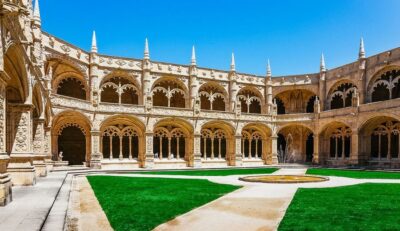
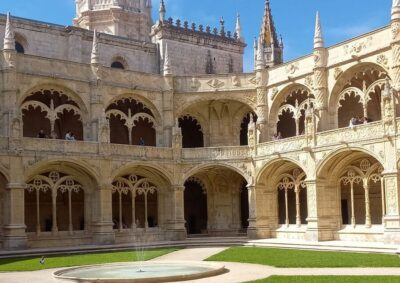
Instead of giving you a lecture you can’t use, the guide focuses attention where your eyes would otherwise slide off. You are guided to the Upper Cloister first, and that’s for a reason. From there, you get spectacular views across the architectural beauty in the complex, and the guide explains the meanings behind the construction, including what it represented for society at the time.
Upper cloister views, and how Manueline design connects to discovery
The Upper Cloister is a great “orientation stop” because it gives you scale. Once you see the layout from above, the lower levels make more sense. I like that the guide also ties the monastery to Portugal’s big historical moment, the Great Portuguese Navigations of the 15th and 16th centuries.
You’ll hear why this site wasn’t created in a vacuum. The architecture is not just decoration. It reflects a society proud enough to build monumental religious spaces at the same time it was expanding routes, trade, and influence overseas.
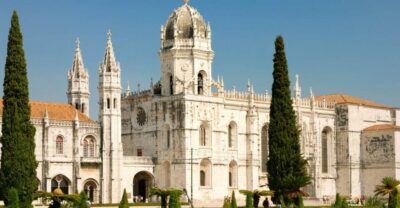
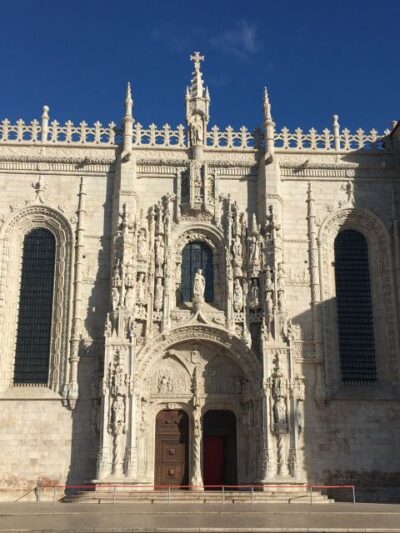
And yes, the style matters. The church is described as a high point of Manueline architecture, a Portuguese style that blends late Gothic structures with Renaissance elements that emerged in the early 16th century. If you ever felt like “everything old looks ornate,” this is the sort of tour that gives you a vocabulary for what you’re actually seeing.
Lower cloister, Chapter Room, old refectory, and Fernando Pessoa’s tomb
After the Upper Cloister, the route drops you into the lower cloister area, where the tour gets more specific about rooms that many visitors simply pass by.
You’ll visit important spaces like the Chapter Room and the old Refectory. The guide also points out the tomb of Fernando Pessoa, which is particularly interesting because it was moved to this space only in the 20th century. That detail helps you understand that the monastery is not frozen in time. It has been used, adapted, and reinterpreted across centuries.
This part is also a reminder that Jerónimos is both religious architecture and a historical record. The tour helps you notice how different eras can overlap in one place, even when the building itself looks tied to the distant past.
Other Lisbon calcada routes we have followed on foot




Santa Maria de Belém church, royal tombs, Vasco da Gama, and Camões
Next comes the church section, Santa Maria de Belém Church. If you only have one “wow moment” here, make it this part. The guide’s approach is to slow you down long enough to understand why it is described as a symbol of the height of Manueline architecture.
The church is also a who’s-who moment for Portugal. The tour highlights burials of prominent names from the Avis dynasty, including King D. Manuel I and his son João III. You also see important figures connected to the navigation era, including Vasco da Gama and Luís Vaz de Camões.
Even if you already know the big names, the guide’s explanations help you connect them to the physical space. It makes the church feel less like a photo spot and more like a statement of power, faith, and national identity.
Empire Square Garden and quick pause, then Monument to the Discoveries
After the monastery complex, you do a short walking segment, about 15 minutes, to reach Empire Square Garden. This is a simple break in the rhythm. It gives your legs a moment to reset, especially if it’s hot or sunny.
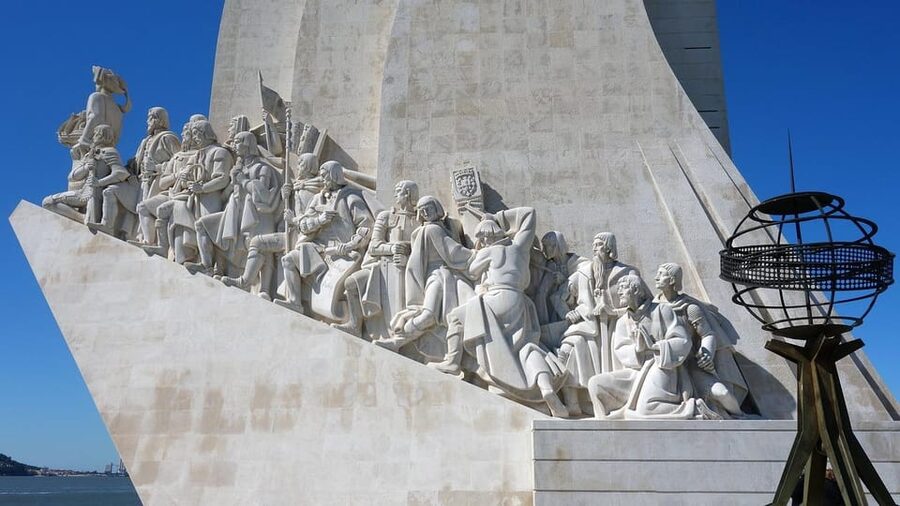
Then you head to the Monument to the Discoveries. Your tour includes guided sightseeing here, around 20 minutes, and it’s worth using that time, because the monument is easy to treat as a backdrop.
The guide explains what it commemorates. It was erected in 1960 to mark the 500th anniversary of Infante D. Henrique’s death, often seen as a main figure in Portuguese navigation. The monument also represents other important characters from the Great Navigation era, people who helped expand Portuguese culture around the world.
For me, the best use of this stop is the “bridge” feeling. Once you’ve seen Jerónimos and heard the Manueline context, the monument stops being random 20th-century sculpture. It becomes a cultural bookmark pointing back to the era you just learned about.
Pastéis de Belém stop, what makes the tart part of the story
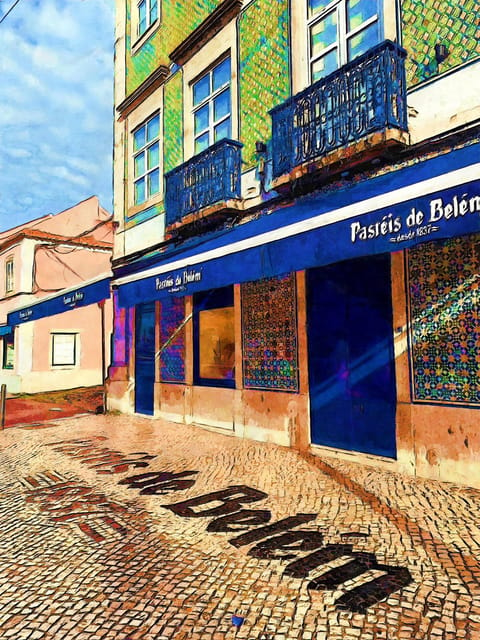
Then comes one of the best breaks in the tour: Pastéis de Belém. The tour schedule includes about 30 minutes for the pastry stop, and importantly, it includes the original custard tart from Lisbon.
This is not just sugar as a reward. The tour frames the tart as something created by the monks connected to the Jerónimos Monastery. It is described as an ancient recipe that has been sold in the same establishment since the mid-19th century.
So you’re tasting a food that ties back to the religious site you just toured. You’ll likely notice that the flavor and texture feel specific to this iconic bakery, and having it built into the route means you’re not trying to time a food hunt while other lines are forming.
If it’s a hot day, this stop is also a breathing moment. Eat, drink water, and use the time to reset before the final monument walk.
Belém Tower during restoration, still worth the outside views
The last leg brings you to the Belém Tower, and here you have to plan with one important reality. The tower is currently undergoing restoration work and cannot be visited inside.
Still, you get guided sightseeing and historical context. The tour includes a short walk of about 15 minutes to reach it, and you’re given the chance to see it as part of the bigger UNESCO-linked area. Jerónimos Monastery and Belém Tower are described as holding the title of World Heritage Site attributed by UNESCO.
The guide explains that the tower is another example of Manueline architecture, and it served as a defensive point against invaders trying to reach Lisbon. Even without interior access, that defensive purpose gives the tower a different meaning. It becomes less of a postcard and more of a strategic object in the story of Portugal’s power and protection.
I also like what some guides do in this situation. One of the recurring themes is that the guide takes care to cover the key points even when you cannot enter, and the exterior views are used to connect the tower back to what you saw in the monastery. You do not feel like you are wasting time, as long as you stay engaged with the explanation while you look.
The guide matters: Luis, Leonardo, Federico, and a similar teaching style
A tour like this lives and dies by the guide, because the sights have few easy signs telling you what everything means. The guides listed across different departures include names like Luis, Leonardo, Leo, and Federico, with a consistent style in how they teach.
Here’s what you can expect from that kind of guide approach:
- They connect carvings and architecture to society and historical events
- They point out details you might otherwise miss, especially in the monastery
- They answer questions instead of pushing you along
- They often use helpful supporting visuals, like pictures that give context
Several comments also mention communication and organization, including clear meeting instructions and guides who make an effort to help you understand what you’re looking at. One recurring practical detail is that some groups receive headsets, which can help in crowded sections where it’s hard to hear.
So if you take one lesson from this review, take this one: don’t just show up for the buildings. Show up ready to look slowly, and let the guide teach you what to see.
Price and value, why $70 can make sense here
The price is listed as $70 per person, and you only get real value if the included parts do what they promise.
In this case, the ticket to Jeronónimos Monastery is included, along with the original Pastéis de Belém and an expert English-speaking guide. The biggest practical value is the skip-the-line access through a separate entrance. When Jerónimos lines are long, that time saved can be the difference between “I saw it” and “I enjoyed it.”
The duration is 3 to 3.5 hours, so you’re not paying for a full-day commitment. You also avoid the stress of trying to time monastery tickets, meal planning, and multiple stops in the same area while other visitors are competing for entry.
Two reality checks keep this balanced:
- Lunch is not included, so you’ll need a plan for afterward.
- The Belém Tower cannot be entered due to restoration, so the tower portion is more about sightseeing and explanation than interior access.
If those fit your expectations, the value is strong for an efficient, story-driven half-day.
What to wear, how to pace yourself, and what can derail you
This is a walking tour with monastery time, so your body matters.
Bring comfortable shoes. Wear comfortable clothes. If you visit in warm months, also bring a sun hat and sunscreen. The tour runs rain or shine, so bring an umbrella too, even if Lisbon looks bright when you leave.
Also, plan your arrival so you are not late. Punctuality is emphasized, and you’ll be joining a group that enters on a set schedule. If you tend to underestimate travel time in Lisbon, build in buffer.
One more practical note: the tour is not suitable for people with mobility impairments or for wheelchair users, so if that applies, you’ll want a different format.
Finally, keep the vibe calm. The rules state no alcohol or drugs and no making noise, which makes sense for places like churches and quiet interior spaces.
Who this tour suits best
This tour is a great match if you want:
- A guided explanation of Manueline architecture
- A structured way to see Jerónimos Monastery without getting stuck in queues
- A meaningful meal stop that connects to the monastery rather than feeling random
- A compact Belem route that ties the monastery to the navigation era
It’s also a good choice for first-time Lisbon visitors who want a high-value morning without needing to drive or manage multiple tickets.
If you prefer totally self-paced museum wandering with minimal explanation, you might find the guided pacing a little structured. But if you like having someone translate the carvings and tomb names into a story, you’ll likely enjoy this style.
Should you book this Jerónimos and Belem walking tour?
Yes, if you care about context and you want to make the most of a short morning. The skip-the-line entry into Jerónimos plus the guided focus on the cloisters, church, and key tombs is the main reason to book. Add the included Pastéis de Belém and you get a tour that feels practical, not just scenic.
Book with expectations aligned to current reality. The Belém Tower is under restoration and cannot be entered, so the tower portion is outside viewing and history. If you’re okay with that, this is a smart way to see the Belém core in a few focused hours.
FAQ
What’s included in the tour price?
You get entrance tickets to Jerónimos Monastery, an original Pastéis de Belém custard tart, and an expert English-speaking tour guide.
Does the tour skip the line at Jerónimos Monastery?
Yes. The tour includes skip-the-line access through a separate entrance.
How long is the tour?
It runs about 3 to 3.5 hours.
What time does the monastery visit happen?
The visit begins at around 9:30 in the morning.
Will I be able to enter Belém Tower?
No. The tour notes the Belém Tower is undergoing restoration work and cannot be visited.
Is lunch included?
No. Lunch is not included.
What should I bring?
Bring comfortable shoes, a sun hat, sunscreen, and plan for rain or sun. The tour indicates you should bring an umbrella as well.
What’s the meeting point?
Meet your guide at the front of the Jerónimos Monastery entrance, near the south entrance to the church, where queues form. There is a specific photo shown for the meeting place, so use it to avoid confusion.
What language is the tour guide?
The tour is offered in English.
Is the tour wheelchair accessible?
No. It is listed as not suitable for wheelchair users or people with mobility impairments.
Other Days Out Around Lisbon





On Foot Around Lisbon, Other Guided Walks




Belem and the Discoveries Monuments, More Visits




Newly added around Lisbon
- Lisbon: Street Art Walk
★ 5.0 · 79 reviews - From Lisbon: Nazare Big Waves and Óbidos Guide Day Trip
★ 4.7 · 79 reviews - Small Group Walking Tour of Belém
★ 4.9 · 80 reviews - Lisbon: Regaleira, Sintra, Cape Rock & Cascais Day Trip
★ 4.6 · 80 reviews - Lisbon: Evening Local Food Crawl with Drink Pairings
★ 4.6 · 80 reviews - From Lisbon: Sintra and Portuguese Coast Private Day Tour
★ 5.0 · 80 reviews - Lisbon: Authentic Fado Show, Dinner and Night Tour
★ 4.6 · 80 reviews - Golden Hour Boat Tour – Sailing by the Monuments with Wine
★ 5.0 · 81 reviews - Hard Rock Cafe Lisbon with Set Lunch or Dinner
★ 4.0 · 81 reviews - Fado Musical Experience with Portuguese Wine & Appetizers
★ 4.5 · 81 reviews
Other boats, other operators: Belem and the Age of Discoveries.
 ★ 4.1Lisbon: Jerónimos Monastery Entrance TicketFrom $2114,164 reviews
 ★ 5.0Private Lisbon Sightseeing Tuk-Tuk Tour: Alfama, Belém & MoreFrom $524,277 reviews
 ★ 5.0Age of Discoveries Walking Tour in BelémFrom $31,513 reviews
 ★ 5.0Bike Tours Lisbon – Center of Lisbon to BelémFrom $19686 reviews
 ★ 3.7Lisbon: Jerónimos Monastery E-Ticket and Audio GuideFrom $33660 reviews
 ★ 4.7Lisbon Bike Tour: Downhill Downtown Lisbon to BelémFrom $45655 reviews
 ★ 4.7Lisbon: Belem Walking Tour with Jeronimos Monastery TicketFrom $61490 reviews
 ★ 4.8Lisbon: Belem, Jeronimos Monastery, and Coach Museum TourFrom $94478 reviews