
REVIEW · WALKING TOURS
3-Hour Guided Street Art Walking Tour of Lisbon
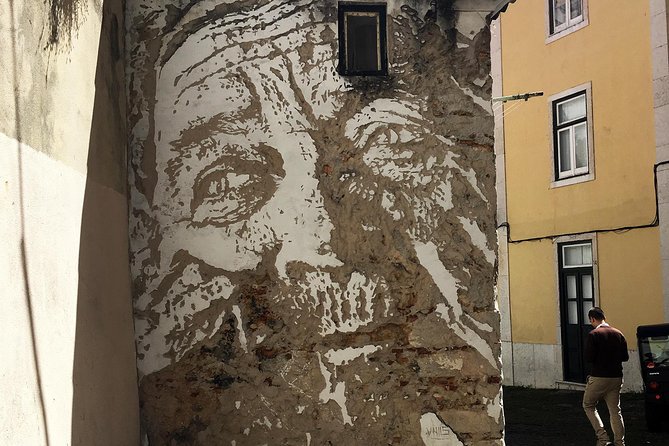
Street art in Lisbon is everywhere, but meaning hides. This 3 hour walk connects murals, graffiti, and even tile symbolism so you know what you are looking at. I love the small group size, and I also love that the guide turns street art into social, cultural, and political context. The one catch is that it is a hill-and-cobblestone type of walking tour, so you need comfortable shoes and solid legs.
You get a plan, not just wandering. Five focused stops keep you moving through neighborhoods like Bairro Alto, Baixa, Graça, and Alfama, with a halfway rest break built in. If you hate walking or have mobility limits, this tour probably will not feel good on your body.
For photographers and art fans, the route is practical. It ends at Miradouro da Graça, which is a nice payoff after the climb, and you will be near public transport at the start and finish. Bring your phone, look up often, and be ready to read walls instead of just buildings.
In This Review
- Key highlights you will actually feel on this tour
- Lisbon street art makes more sense when you walk it
- Where you meet, where you end, and how the route stays simple
- Stop 1, Bairro Alto: street art tied to nightlife traditions
- Stop 2, Elevador da Gloria: an urban art gallery feeling
- Stop 3, Baixa de Lisboa: tiles and cobblestones with stories
- Stop 4, Miradouro da Graça: Graça street art and workers rights
- Stop 5, Alfama and Chão do Loureiro: a car park turned gallery
- The guides are the difference, and they make the art legible
- Pace, hills, and the halfway rest break that saves your feet
- Price and value: why 42.27 USD can be a fair deal here
- Who will love this tour the most
- Photography tips for street art corners and tile details
- Should you book this Lisbon street art walking tour?
- FAQ
- How long is the Lisbon street art walking tour?
- What is the price per person?
- Is the tour guided, and what is included?
- Is the tour only for people who already know street art?
- What language is the tour offered in?
- Where do I meet the guide and where does the tour end?
- Are tickets mobile, and do I get confirmation after booking?
- Is food or drink included?
- Do I need hotel pickup or drop off?
- Is this tour accessible for people with mobility issues?
Key highlights you will actually feel on this tour

- Small group format (maximum 12 people) means more time to ask questions
- Five tight stops in Lisbon’s best street art neighborhoods, each around 30 minutes
- Context focused guide links murals and graffiti to Lisbon’s social stories
- Halfway rest break so you can reset without slowing the tour
- Walking route on uneven terrain, so comfy shoes are not optional
- Mobile ticket in English, with confirmation after booking
Other Lisbon calcada routes we have followed on foot
- Lisbon: History, Stories and Lifestyle Walking Tour★ 4.8 · 10,902 reviews
- Best of Lisbon Small-Group Guided Walking Tour★ 5.0 · 4,869 reviews
- Best of Lisbon Walking Tour: Rossio, Chiado & Alfama★ 4.9 · 2,700 reviews
- Age of Discoveries Walking Tour in Belém★ 5.0 · 1,513 reviews
Lisbon street art makes more sense when you walk it
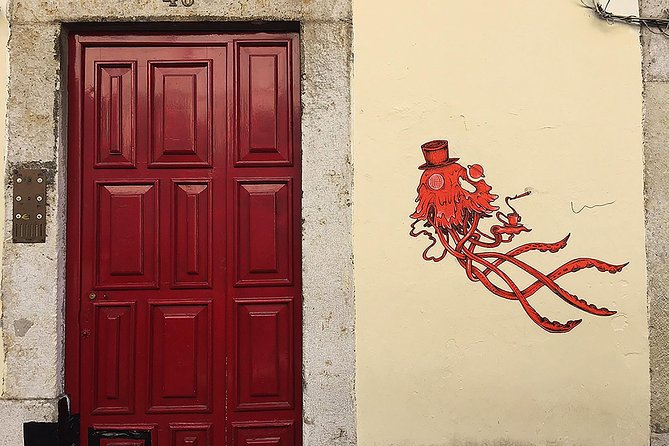
Lisbon has a talent for putting art where you live your day. On this tour, you get the map in your head, not just photos on your camera roll. After a few turns, street art stops feeling random and starts feeling like part of the city’s language.
I like that you do not have to guess what you are seeing. The guide helps you spot patterns, understand symbols, and connect art to where it appears. You also cover neighborhoods that are easy to miss when you only follow the usual sightseeing route.
This is not a sit-down museum style experience. You are outside, often on uneven ground, and you are watching the city as much as the artwork.
Where you meet, where you end, and how the route stays simple
The tour starts at R. Luz Soriano 67, 1200-246 Lisboa. You finish at Miradouro da Graça, Calçada da Graça, 1100-265 Lisboa. That matters because it shapes your timing, especially if you want to continue exploring right after the tour.
You also get good everyday convenience. You will have a mobile ticket, you will be walking near public transportation, and the tour runs with a local guide. Hotel pickup and drop off are not included, so plan to arrive on your own.
Your best move is to wear shoes that can handle cobblestones and sloping streets. The tour requires you to walk on unpaved or uneven terrain, and it is not recommended for mobility issues. Service animals are allowed, so that is a plus if you travel with one.
Stop 1, Bairro Alto: street art tied to nightlife traditions
Bairro Alto is a neighborhood people associate with evenings out, and its street art follows that vibe. The stop here is about 30 minutes, focused on the street art scene tied to the area’s nightlife traditions.
What I like about this stop is how it sets expectations. Instead of presenting street art as only political or only decorative, you see it as a culture signal. The guide helps you read what is going on, so you are not just looking at pretty images.
The drawback is that Bairro Alto can feel more active than other parts of the city. If you get overwhelmed in louder, busier streets, take it slow and focus on one wall at a time.
Stop 2, Elevador da Gloria: an urban art gallery feeling
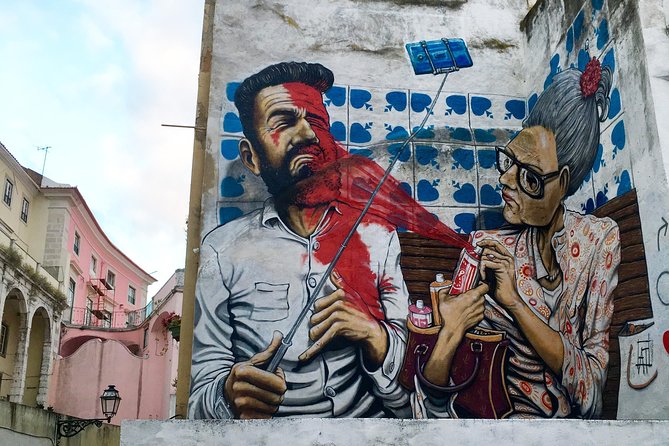
Next you head toward the Elevador da Glória area, where Calçada da Gloria acts like an urban art gallery. Street artists from all over the world contribute to projects here, which makes it feel more like a living international exchange than a single neighborhood style.
This is another 30 minute stop, and it is a good one for photos. You are likely to notice how artists use the city’s surfaces as part of the composition. Also, because this is an area where multiple projects gather, you get a chance to compare styles quickly.
One practical note: the route and angles may vary by day. Lisbon changes with weather and light, so for the best shots, pause, then shoot. Rushing leads to blurry tiles and half-cropped murals.
Other guide-led outings in Lisbon we have booked



Stop 3, Baixa de Lisboa: tiles and cobblestones with stories

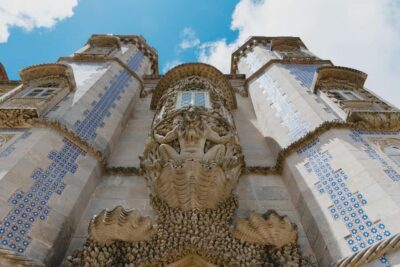
In Baixa de Lisboa, the focus shifts to symbols and design in the city’s famous coverings. You spend about 30 minutes looking at how Lisbon’s azulejos tiles and cobblestone streets carry meaning.
This stop is smart because it expands what street art can mean in Lisbon. It is not only graffiti and murals. You learn to pay attention to the decorative systems already built into the city, and how symbols show up in everyday spaces.
The nice part: even if you think you are only into modern street art, this stop helps you understand Lisbon’s older visual language. The possible downside is that this is a more detail-oriented stop. If you want only big, fast wall art, you might feel you are studying more than you expected.
Stop 4, Miradouro da Graça: Graça street art and workers rights
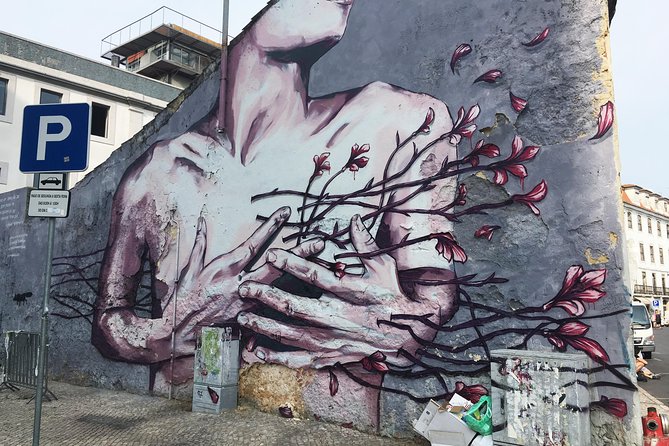
Then you head to Miradouro da Graça (Sophia de Mello Breyner Andresen) and the neighborhood of Graça behind it. This area is residential, and the street art reflects a historical connection to Portugal’s workers unions and workers rights.
This is where the tour gets deeper without turning into a textbook. You start seeing street art as a voice. The guide helps translate the visual cues into social context, so you can connect what you see to the city’s people and struggles.
Because this is tied to a viewpoint and a residential area, the pace feels different than the busier streets. That can be a good thing. Still, remember you are in Lisbon, so you will likely be walking on uneven terrain and climbing hills again.
Stop 5, Alfama and Chão do Loureiro: a car park turned gallery
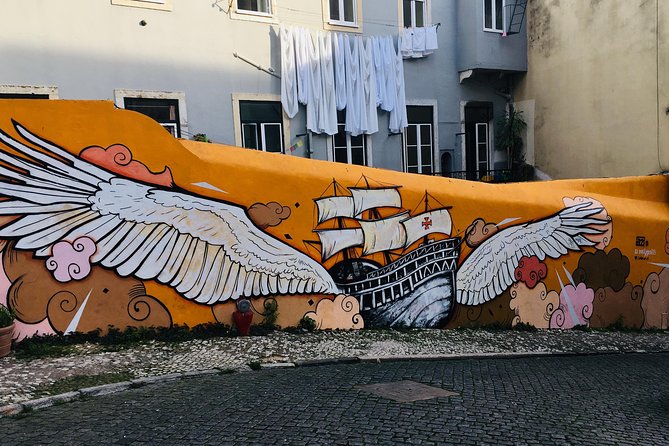
The final stop in Alfama takes you to Chão do Loureiro, described as a car park transformed into a street-art gallery. The building is five floors, and it showcases work from prominent street artists of Lisbon’s south margin.
This stop is a strong ending because it feels like a concentrated dose. Instead of one mural here and one tagging there, you get a multi-level space where you can see variety and scale. It is also a great place to slow down and let your eyes adjust to different styles.
The one consideration is that five floors means there is a lot to take in, and you may want to move at your pace. If you need frequent breaks, this is where you will likely appreciate the earlier rest you got at the halfway point.
The guides are the difference, and they make the art legible
The reviews you would expect to see for a tour like this often point to one thing: the guide. On this walk, the guide’s job is to connect the artwork to place and meaning, not just name locations.
Guides such as Erika and Maria are highlighted for being able to explain street art as more than graffiti. They cover murals, graffiti, and buildings decorated with tiles and enlightenment-era art, which helps you stop treating Lisbon’s visuals as separate categories. Guides like Leigh and Laith are praised for linking methods and style to broader social issues and world street art, and for keeping the pacing fun.
Even without a specific guide name, the pattern is clear: you are paying for interpretation. That is where value shows up. If you were to wander alone, you might see plenty of art, but you might miss why it exists and why it appears in that exact spot.
Pace, hills, and the halfway rest break that saves your feet
This tour runs for about 3 hours and includes a rest break halfway point. That break is not just comfort, it also helps you keep your attention sharp for the last two stops. When you are walking hills, fatigue can mess with your ability to notice details in the art.
The tour is a walking format with five stops, each roughly 30 minutes. There is time to look, ask, and reposition your angle without feeling like you are always rushing. Still, walking times are real. Lisbon has slopes and uneven surfaces, so plan around that.
It is also a small group experience. Maximum group size is 12 pax, and the overall maximum for the activity is 15 travelers. Either way, the group is small enough for questions, but big enough that you are not trapped one-on-one with an overly chatty stranger.
Price and value: why 42.27 USD can be a fair deal here
At $42.27 per person for about 3 hours, this is not a budget miracle, but it is also not overpriced for what you get. You pay for a local guide, a small group setting, and a structured route through places you might not prioritize on your own.
Here is the practical value equation. Street art in Lisbon is spread out and tied to specific neighborhoods. Without guidance, you can end up covering the wrong streets or missing the symbolic details. With the guide, you trade some freedom for time savings and meaning.
Also, admission is free at each stop listed, so your money mostly goes to the guide and the route design. For art and photography lovers, that is the key bargain: you are paying to see more clearly.
Booking can be popular. This tour is often booked about 26 days in advance, which tells you it is not the kind of thing you should assume you can take off the shelf at the last minute.
Who will love this tour the most
This is a great fit if you:
- care about street art and want context, not just pictures
- enjoy walking Lisbon neighborhoods, especially ones with distinctive character
- want a route that helps you avoid getting lost
- like photography and want permission to slow down and look closely
It is also a strong choice if you are traveling solo. One of the best feelings on tours like this is arriving back at the end point without stress. A guide-led walk helps you feel oriented, especially in a city with hills.
What might not work as well:
- people who cannot handle uneven terrain
- anyone who expects an easy, flat promenade
- travelers who want minimal walking and minimal stops
Photography tips for street art corners and tile details
This tour is built for looking. Since you are covering multiple neighborhoods, your best photos will likely come from small choices.
First, use your eyes before your camera. Tiles and symbols in Baixa need slower looking than large murals. In Bairro Alto and Graça, street art can connect to street life, so watch angles where the wall meets the street.
Second, bring a charged phone or camera and take a few steps before shooting. Street art often reads better when you are slightly back or slightly above. The route includes viewpoints like Miradouro da Graça, so expect at least some shots where the view and wall both matter.
Finally, keep your questions ready. A good guide can point you to what makes a piece meaningful, not just what it looks like. That turns your photos into souvenirs with a story.
Should you book this Lisbon street art walking tour?
If you love street art and want it explained in a way that connects to Lisbon’s neighborhoods, book this. The small group size, the structured stops, and the fact that the guide ties together murals, graffiti, and even tile symbolism make it a practical and smart use of a limited time window.
Skip it if your legs need flat ground. This is a walking tour with hills and uneven terrain, and it is not recommended for mobility issues. Also, if you only want famous landmarks and minimal walking, you might find it too focused on walls and neighborhoods.
For everyone else, this is one of the best ways to feel Lisbon from the ground up. You will walk away seeing the city with sharper eyes, and you will know how to spot meaning long after the three hours are done.
FAQ
How long is the Lisbon street art walking tour?
It is approximately 3 hours.
What is the price per person?
The price is $42.27 per person.
Is the tour guided, and what is included?
Yes, it includes a local guide, a rest break at the halfway point, and a small group tour.
Is the tour only for people who already know street art?
Most travelers can participate, including people who are new to street art. The tour focuses on explaining what you see.
What language is the tour offered in?
The tour is offered in English.
Where do I meet the guide and where does the tour end?
You start at R. Luz Soriano 67, 1200-246 Lisboa, Portugal. The tour ends at Miradouro da Graça, Calçada da Graça, 1100-265 Lisboa, Portugal.
Are tickets mobile, and do I get confirmation after booking?
Yes, you get a mobile ticket. Confirmation is received at the time of booking.
Is food or drink included?
No, food and drinks are not included.
Do I need hotel pickup or drop off?
No. Hotel pickup and drop off are not included.
Is this tour accessible for people with mobility issues?
It is not recommended for travelers with mobility issues. You must be able to walk on unpaved or uneven terrain. Service animals are allowed.
Other Days Out Around Lisbon





Guide-Led Outings in Lisbon, More Bookings





On Foot Around Lisbon, Other Guided Walks



Newly added around Lisbon
- Lisbon: Street Art Walk
★ 5.0 · 79 reviews - From Lisbon: Nazare Big Waves and Óbidos Guide Day Trip
★ 4.7 · 79 reviews - Small Group Walking Tour of Belém
★ 4.9 · 80 reviews - Lisbon: Regaleira, Sintra, Cape Rock & Cascais Day Trip
★ 4.6 · 80 reviews - Lisbon: Evening Local Food Crawl with Drink Pairings
★ 4.6 · 80 reviews - From Lisbon: Sintra and Portuguese Coast Private Day Tour
★ 5.0 · 80 reviews - Lisbon: Authentic Fado Show, Dinner and Night Tour
★ 4.6 · 80 reviews - Golden Hour Boat Tour – Sailing by the Monuments with Wine
★ 5.0 · 81 reviews - Hard Rock Cafe Lisbon with Set Lunch or Dinner
★ 4.0 · 81 reviews - Fado Musical Experience with Portuguese Wine & Appetizers
★ 4.5 · 81 reviews
Other boats, other operators: Walking Tours.
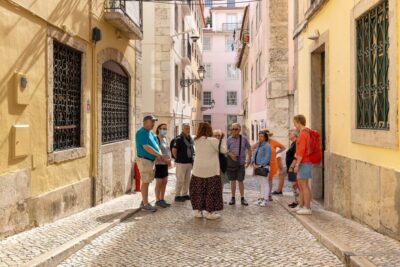 ★ 4.8Lisbon: History, Stories and Lifestyle Walking TourFrom $2910,902 reviews
 ★ 5.0Best of Lisbon Small-Group Guided Walking TourFrom $234,869 reviews
 ★ 4.9Lisbon: Food and Wine Small Group Walking TourFrom $724,082 reviews
 ★ 5.0Porto Walking Tour, Lello Bookshop, River Cruise and Cable CarFrom $723,354 reviews
 ★ 4.7Funchal: Old Town Walking TourFrom $193,233 reviews
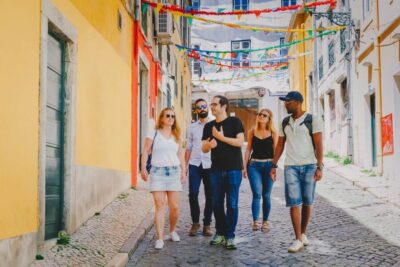 ★ 4.9Best of Lisbon Walking Tour: Rossio, Chiado & AlfamaFrom $232,700 reviews
 ★ 5.0Experience Porto’s Charm: 3-Hour Guided Walking TourFrom $352,432 reviews
 ★ 4.7Madeira: Enjoy a Guided Levada Walk in the Rabaçal ValleyFrom $502,197 reviews